
READ THE FULL RADX RESEARCH REPORT
Radiopharm Theranostics Limited (NASDAQ:RADX) held two key opinion leader (KOL) events: one at the end of August and the other at the beginning of September. The events highlighted the company’s work in prostate cancer pursuing both the B7-H3 and KLK3 targets, which are used by Radiopharm’s RV01 and RAD402 radiopharmaceutical candidates, respectively. Both of the presentations were hosted by Radiopharm’s Chief Medical Officer, Dr. Dimitris Voliotis and began with an introduction of the speakers. The first event was held on August 27th and featured Dr. Oliver Sartor and Dr. David R. Piwnica-Worms while the second event was held on September 2nd and featured Dr. Hans David Ulmert and Radiopharm CEO Riccardo Canevari.
B7-H3 Targeted Radiotherapy
The August 27th KOL event featured Dr. Oliver Sartor of Tulane University, among other prestigious affiliations, and Dr. David Piwnica-Worms of the MD Anderson Cancer Center. The presentation began with a review of prostate cancer treatment. It traced its evolution from treatments centered on surgery, radiation, and chemotherapy to more modern approaches using targeted therapy, immunotherapy, and molecularly targeted radiation.
Prostate cancer is divided into two main groups: castrate sensitive and castrate resistant. The former is responsive to hormonal therapy while the latter is not. Further divisions include metastatic and non-metastatic disease, each of which calls for a different treatment approach.
Metastatic castrate resistant prostate cancer (mCRPC) represents a diverse disease with more than 30 subtypes. Because of this variability, a single precision therapy can only benefit a subset of patients. Broadly expressed targets like B7-H3 are therefore especially valuable in developing effective treatments and can be used in a wider array of patients.
Dr. Sartor reviewed several Phase III trials in mCRPC evaluating products including docetaxel, Sipuleucel-T, abiraterone, and enzalutamide, among others. Each showed an overall survival benefit over the control, ranging from 2.4 months to 8.8 months. However, the benefit did not dramatically improve survival, leaving an unmet need. Dr. Sartor noted that “…everybody with mCRPC is going to progress and die from their disease” under existing treatment modalities bringing into relief the need for dramatically improved therapies. He also pointed out that the sequence of mCRPC treatment is important for determining what is administered in later lines of therapy.
Following an explanation of the radioisotope design, Dr. Sartor reviewed the PEACE III trial which evaluated the combination of enzalutamide plus radium‑223 versus enzalutamide alone in men with mCRPC and bone metastases. Interim data for the trial showed an overall survival (OS) benefit of 7.3 months. This was cited to show the efficacy of using a radioisotope as part of the treatment regimen.
Dr. Sartor authored the New England Journal of Medicine article entitled Lutetium-177-PSMA-617 for mCRPC. The product referenced in the article, better known as Pluvicto, was first approved in March 2022 based on data from the VISION trial. The VISION study met both primary endpoints of OS and progression free survival (PFS) adding four months of life for the average patient. Pluvicto received an expanded approval by the FDA in March 2025 to include adults with PSMA-positive mCRPC who have had androgen receptor (AR) pathway inhibitor therapy and are appropriate candidates to delay taxane chemotherapy. These interim results were generated from the PSMAfore trial. Based on the data in these trials, Dr. Sartor believes that there is a significant unmet need for better therapies in mCRPC and that radiopharmaceuticals provide an attractive modality. He identifies the primary unmet needs as OS limited to two years post-treatment, difficult side effect profile for chemotherapy and castration and lack of other approved drugs post-Pluvicto.
After his 15-minute presentation, Dr. Sartor handed the baton to the second KOL guest, Dr. David R. Piwnica-Worms, who introduced the B7-H3 immune checkpoint target and Radiopharm’s Lu-177 Betabart candidate designated RV01. B7-H3 is an attractive pan-tumor target and is expressed in prostate, breast, colon, lung and gastric tumor tissue. Staining work shows that the target is not expressed in normal tissue in these sites.
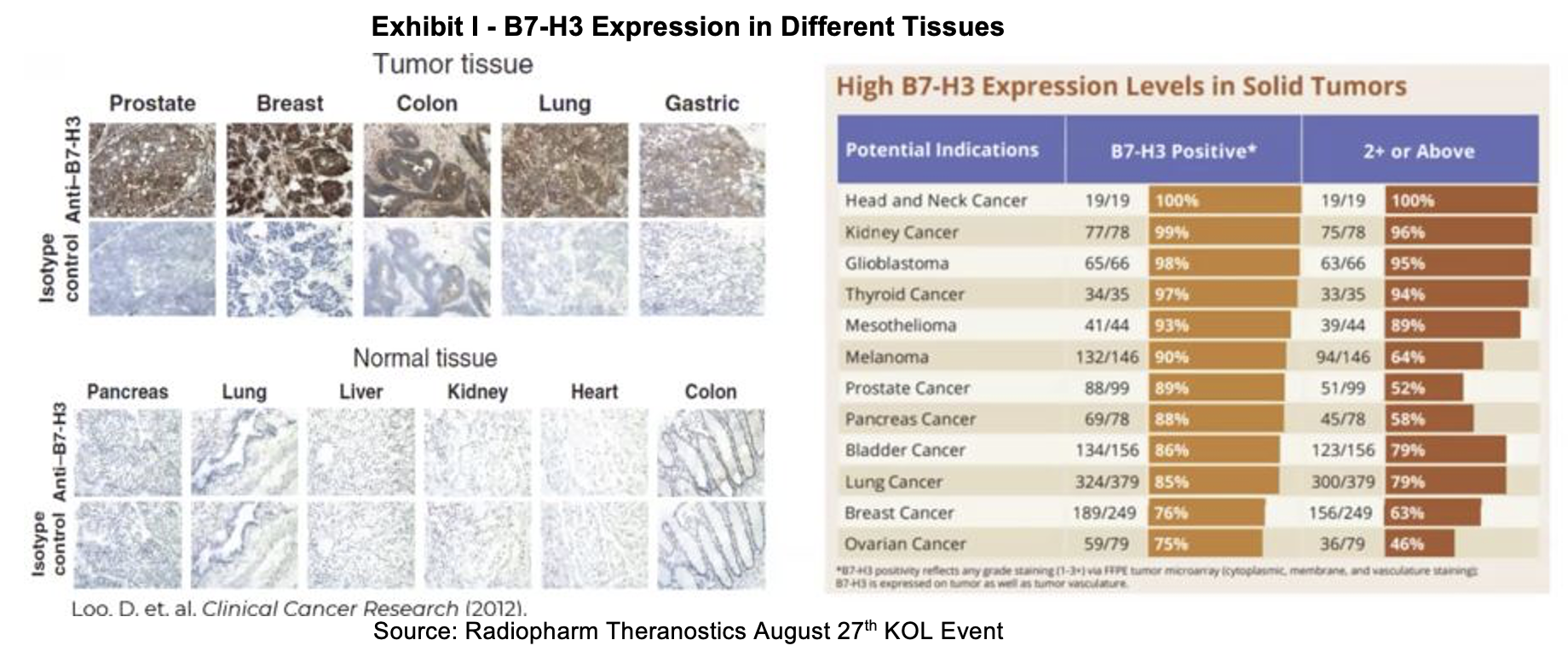
B7-H3 is an alternative target when prostate-specific membrane antigen (PSMA) targeting therapies fail. The rationale behind its attractiveness is that B7-H3 is expressed very early in the evolution of the disease, and its expression is consistent between primary and metastatic sites. The checkpoint’s expression is also consistent between castrate-sensitive and castrate resistant tissue. Other features of the immune response regulator are its overexpression in prostate cancers with defective DNA repair genes and negative correlation with mismatch repair defect (MMRd) status. In his presentation, Dr. Piwnica-Worms referenced 11 Phase I or II active or completed clinical trials that are evaluating the B7-H3 target.
One of the features of B7-H3 is that it is expressed as multiple isoforms: 4Ig and 2Ig. The 4Ig isoform is dominant and is membrane bound while the 2Ig form is soluble and circulates through the blood. This has implications for the design of a binding ligand. If a therapeutic targeting agent binds to the 2Ig isoform, very high doses will be needed to deliver sufficient B7-H3 to the target tumor tissue. If the targeting agent can only bind to the 4Ig isoform, which only appears on tumors and within the tumor microenvironment, then lower doses of the treatment can be used, reducing side effects and radiation exposure in the case of RV01.
The event continued with Dr. Piwnica-Worms providing an overview of prostate cancer treatment, highlighting the unmet needs in metastatic castrate resistant prostate cancer (mCRPC). Despite the double-digit number of early studies, none of them employed radioisotopes for treatment, although other monoclonal antibodies targeting B7-H3 exist. Betabart, Radiopharm’s B7-H3 binding monoclonal antibody, sought to improve on the characteristics of these candidates by achieving picomolar affinity vs nanomolar affinity to the target and selectivity for the 4Ig isoform over the 2Ig isoform.
Betabart has broader applicability and multi-indication potential in B7-H3 positive tumors and has shown early evidence of efficacy in prostate, pancreatic, hepatocellular, colorectal, triple negative breast, lung, ovarian, and endometrial cancers.
Further modifications of Betabart include the introduction of mutations into the FC domain of the antibody. This change will accelerate its clearance from circulation and decrease marrow binding where the B7-H3 receptors are present. These changes will reduce off-target radiation exposure as demonstrated in a mouse model.
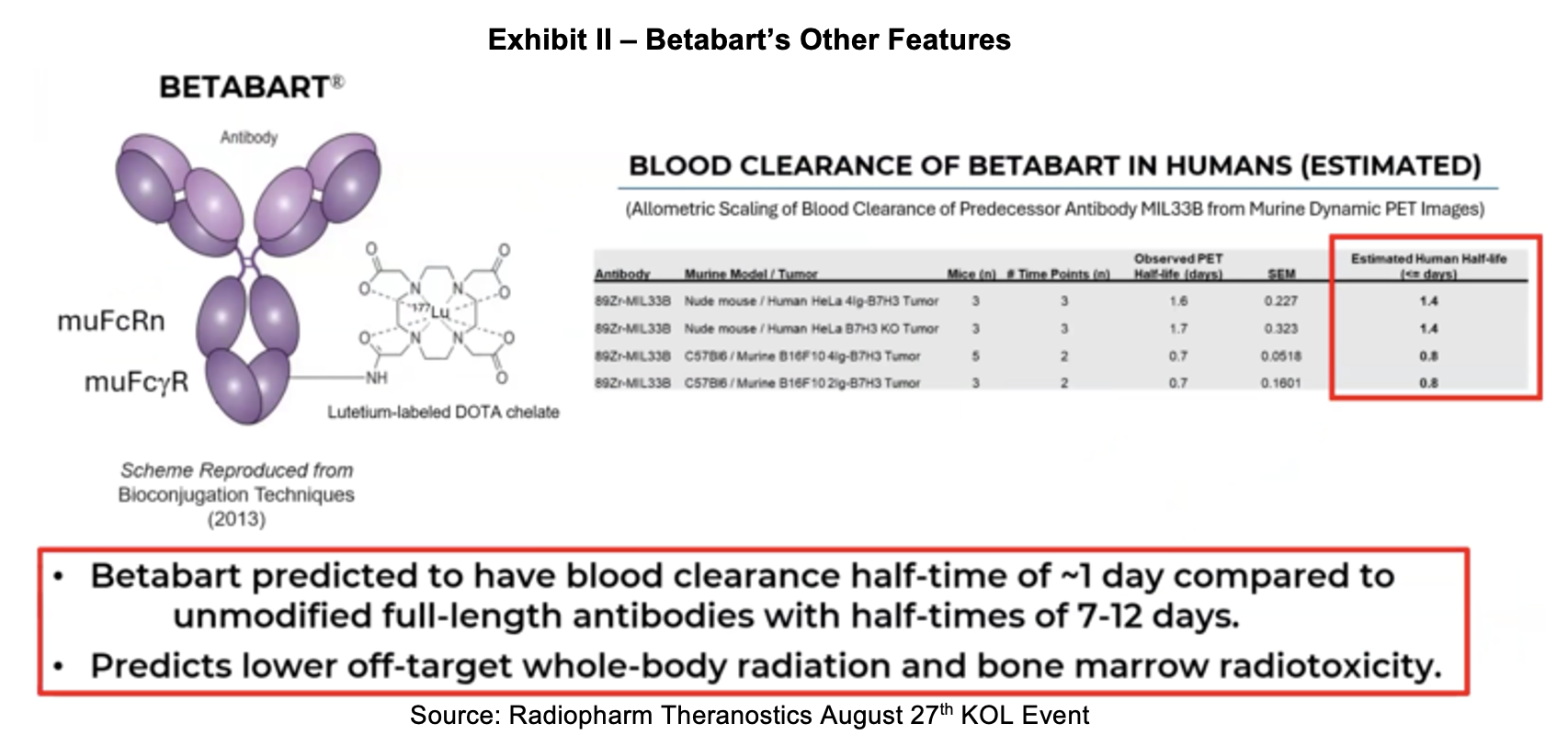
Following the discussion of his slides, Dr. Piwnica-Worms summarized Betabart’s features:
- Represents a best-in-class, high affinity humanized IgG1 antibody
- Demonstrates 300x greater selectivity for the 4Ig isoform compared to the 2Ig form
- Engineered with Fc mutations to increase blood clearance and liver extraction rate with reduced bone marrow affinity
- Provides PET/SPECT imaging properties in vivo
- Supported by mouse model data
The Betabart candidate will be the subject of a basket study looking at a variety of tumors beginning later this year.
KLK3 Targeted Radiotherapy
The second KOL event was held on September 2nd and featured Dr. H. David S. Ulmert from UCLA. He was joined by hosts, Dr. Dimitris Voliotis and Radiopharm CEO Riccardo Canevari. Dr. Ulmert presented the prostate kallikrein (hK2/PSA) targeted radioimmunotheranostic RAD402 and its surrounding framework.
The guest began with a background on the human kallikrein related peptidase 2 (KLK2) and prostate specific antigen (PSA or KLK3), noting that it is only found in a few species and is specifically expressed in prostate tissues. This is in contrast to prostate-specific membrane antigen (PSMA) which, in addition to the prostate is also found in salivary glands, lacrimal glands and kidneys, among other sites. While minute levels of the two kallikreins (KLK2 and KLK3) circulate in the blood, they are rapidly inactivated by protease inhibitors. An exhibit provided in the slide deck illustrated over 100 different tissues where material levels of PSMA appear. KLK2 and KLK3 only appear in high levels in the prostate. This localized expression is expected to limit off target effects and reduce side effects.
KLK2 and KLK3 are closely related members of the kallikrein family of serine proteases. Studies are conducted using the KLK2 target because the two genes and their protein products are similar in structure, function and regulation. Both KLK2 and KLK3 have genomic proximity, high homology (80% sequence similarity with active sites highly conserved) and are both strongly driven by AR signaling. Murine models lack a functional KLK3 gene which directs investigators to use the KLK2 ortholog in conducting preclinical studies in these animal models.
The presentation referenced a mouse study to evaluate KLK2-expressing tumors treated with a radioisotope. Dr. Ulmert observed that as the DNA damage repair mechanism increases, the expression of androgen receptors (ARs), KLK2 and KLK3 are also upregulated. This produces more targets for the antibody, thereby increasing the effect of the drug. The study demonstrated tumor uptake in the prostate tissue of the mouse and that late and enzalutamide-resistant disease can be targeted.
The upregulation of AR expression in PSMA treatment as its efficacy declines makes KLK3 targeting therapy an attractive approach in post-Pluvicto settings. This is due to elevated KLK3 levels in the prostate following treatment.
Johnson & Johnson (J&J) has conducted work on this target using an Indium-111 radioisotope. Its human imaging study found tumor uptake and limited off-target accumulation in dose-limiting organs such as the salivary glands and kidneys. The radiotracing study also demonstrated that the KLK2 target was co-located with the PSMA target in tumor tissue, thereby allowing for more specificity than can be achieved with the latter. This work supported J&J’s later launch of an ongoing Phase I study to measure therapeutic response. The J&J studies have shown that the KLK2 radioisotope can precisely target tumors in patients with mCRPC and can deliver deep and durable reduction in cancer markers for patients with mCRPC who do not respond to other treatments.
This background work has set the stage for moving forward with a kallikrein-targeting isotope because:
- It is expressed at higher levels than KLK2 enabling better targeting and delivery to tumors
- It has been studied extensively with over 27,000 publications and in multiple Phase I/II trials, providing vital background that lowers development risks and accelerates clinical progress
- It is a reliable biomarker for screening, diagnosing and monitoring prostate cancer
Radiopharm is using the Terbium-161 radioisotope for its warhead linked to the KLK3 antibody. This radioisotope has several attractive features including the emission of both beta particles and Auger electrons which can improve its killing ability.
Dr. Ulmert continued his discussion by describing the mechanism of action for the KLK3 binding antibody. When the antibody binds to the KLK3 epitope on the surface of the serine protease, the radioisotope is internalized and is able to target its Auger, alpha or beta radiation precisely. Radiopharm’s Tb-161 radioisotope is particularly appropriate given its emissions. Tb-161’s beta particles and Auger electrons have medium and short-range reach respectively. Auger electrons are only effective if they are very close to the nucleus, which is effective since the KLK3 targeting monoclonal antibody and its associated Tb-161 radioisotope are internalized.
Radiopharm plans to run its first RAD402 study in Australia early next year.
SUBSCRIBE TO ZACKS SMALL CAP RESEARCH to receive our articles and reports emailed directly to you each morning. Please visit our website for additional information on Zacks SCR.
DISCLOSURE: Zacks SCR has received compensation from the issuer directly, from an investment manager, or from an investor relations consulting firm, engaged by the issuer, for providing research coverage for a period of no less than one year. Research articles, as seen here, are part of the service Zacks SCR provides and Zacks SCR receives payments totaling a maximum fee of up to $50,000 annually for these services provided to or regarding the issuer. Full Disclaimer HERE.