
READ THE FULL LEXX RESEARCH REPORT
Lexaria Bioscience Corporation (NASDAQ:LEXX) reported fiscal third quarter 2025 results via the filing of its Form 10-Q. Since our previous quarterly report at the end of April, the company has provided an update on its Material Transfer Agreement, attended BIO, completed the GLP-1-H25-5 study and reached a milestone of 50 patents granted worldwide. The company also compiled key safety data from its GLP-1-H24-4 study supporting the favorable safety and tolerability profile of DehydraTECH (DHT) -formulated GLP-1 agonists. In this report we will bring investors up to date on recent activity and review third quarter financial performance.
Third Quarter 2025 Results
Lexaria filed its Form 10-Q reporting quarterly results for the three-month period ending May 31st, 2025. The company reported revenues of $174,000 and total operating expense of $3.8 million resulting in net loss of ($3.8) million or ($0.21) per diluted common share.
For its fiscal third quarter and versus the comparable prior year period:
- Revenue totaled $174,000, up 107% from $84,000 due to increases in licensing revenues related to the agreement with Premier;
- Research and development expenses totaled $2.7 million, up 370% from $0.6 million as a result of increased expenses related to the Phase Ib GLP-1 agonist trial and investigational drug product manufacturing;
- General and administrative expenses totaled $1.2 million down 4% from $1.3 million due to lower accounting and professional fees;
- Interest income was essentially $0 in both periods;
- Other loss of ($40,000) represented unrealized loss on marketable securities related to decreases in fair value;
- Net loss was ($3.8) million, or ($0.21) per share, compared to net loss of ($1.8) million or ($0.13) per share.
As of May 31st, 2025, cash and marketable securities totaled $4.6 million which compares to $6.6 million at the end of fiscal year 2024. Cash burn for the first nine months of FY:25 was approximately ($7.9) million. Cash from financing over the same period totaled $6.0 million from equity sales. Management estimates that the company holds sufficient cash to meet its financial obligations until second quarter 2026.
Cyprumed Partnership
Deal activity has picked up in recent months with almost 90 transactions taking place year to date. We see this as a good sign as established biopharmaceutical companies contend with their patent cliffs and look to new technologies to achieve growth. One deal stands out to us with relevance to Lexaria that took place between Merck & Co. and Cyprumed GmbH. In the arrangement, Merck gains a license and option to develop oral formulations of its peptides using Cyprumed’s drug delivery technology. Cyprumed will be eligible to receive $493 million in upfront, development, regulatory and net sales milestones associated with the approval of any products under the collaboration. Notably, Cyprumed has not conducted clinical trials and has demonstrated oral bioavailability of up to 70% in rodents, dogs and non-human primates.
Cyprumed is developing technology platforms for the oral administration of therapeutic peptides, including GLP-1 analogues, macrocycles and mini-proteins. Its proprietary delivery platforms feature tablet formulations that offer superior oral bioavailability and build on already approved pharmaceutical excipients. Cyprumed’s objective is to provide easy to manufacture, patient-friendly oral dosage forms of peptide therapeutics.
Peptide therapeutics are one of the fastest-growing drug classes, but most are still administered parenterally due to GI tract limitations such as low pH, proteases, mucus and tight epithelia. Cyprumed uses pH-programmable enteric layers for precise timing of delivery.
We see this deal as promising for Lexaria which has shown clinical evidence of safety and efficacy of oral delivery of peptides including liraglutide, semaglutide and tirzepatide. As the focus of next generation GLP-1 agonists shifts towards improving the safety profile, we see a place for DehydraTECH in the pantheon of drug delivery technologies.
GLP-1-H25-4 Interim Results (Fourth Study)
Lexaria provided an interim look into its GLP-1-H25-4 study highlighting the reduction in side effects for the DHT formulated GLP-1s with the approved versions of the drug. At eight weeks, the DHT-semaglutide arm saw a 36.5% reduction in overall side effects and 43.5% lower gastrointestinal side effects compared to results in the Rybelsus arm. Below is a summary of the adverse event (AE) profile for the study.
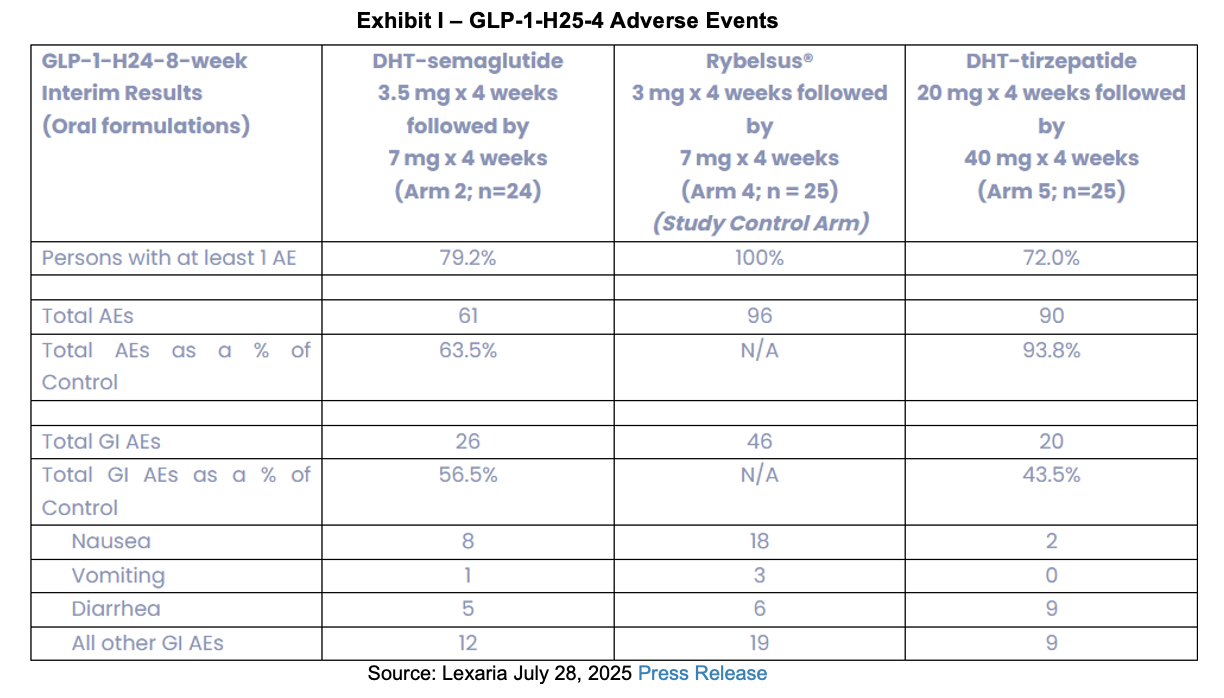
Lexaria’s press release documented at least one AE for each of the 25 subjects in the Rybelsus arm. Five subjects in the DHT arm (5/24) experienced no AEs (referenced as a 20.8% reduction in Lexaria’s press release). A study cited by Lexaria (Bergmann, et al. 2022) found just under 90% of semaglutide patients in the study experienced an AE. The press release compares this to DHT-semaglutide’s AE rate of 79.2%. However, the comparison must be placed in the context of the Lexaria data at the 8-week mark and including 24 people compared to the n of >1,000 for injected semaglutide. Lexaria reviewed several tirzepatide studies and found a similar incidence of AEs as they did for semaglutide in a meta-analysis (Mishra et al. 2023). The study noted a positive correlation between dose level and incidence of AEs. Another remarkable takeaway from the meta-analysis is the high rate of gastrointestinal (GI) -related AEs which comprised up to 50% of the total AEs for injectable tirzepatide. Lexaria compared this hurdle to the 22% rate achieved with DHT-semaglutide in the 8-week study.
Changes in glycated hemoglobin (HbA1c) and weight were other measured endpoints in the GLP-1-H24-4 study. Lexaria extracted these same metrics from Novo Nordisk’s Pioneer studies[1],[2]. DHT-semaglutide was able to reduce HbA1c and weight over the eight weeks, but at a lesser magnitude than what was achieved by Rybelsus. While DHT-semaglutide achieved lower levels of weight loss and HbA1c reduction compared to Rybelsus, it also is associated with reduced side effects, especially gastrointestinal ones. We think that 8-week data is insufficient for making significant comparisons. The primary takeaways are that the trend in endpoints is moving in the right direction and that reduced adverse events will allow for a greater number of patients to continue on a therapy so they can obtain its benefit. Lexaria also brought attention to the focus on adverse events with a quote[3] from Martin Hoist Lange, who was promoted to Chief Scientific Officer of Novo Nordisk earlier this week: “We want to win the weight loss [battle] but we also want to have a gastrointestinal adverse event profile that is attractive and competitive.”
GLP-1-H25-5 Completion and Safety Data (Fifth Study)
Lexaria received independent review board (IRB) approval in January, clearing the start of its Human GLP-1 Study #5 (GLP-1-H25-5). It compared an oral version of liraglutide (Saxenda) formulated from the DHT processing of liraglutide (DHT-liraglutide) to the conventional injected liraglutide. This study was instigated by the successful results in the liraglutide 12-week rodent study which read out in November 2024. DHT-liraglutide reduced weight and blood sugar at levels exceeding the performance of comparator Rybelsus. On April 2nd, Lexaria announced that it had begun dosing patients in study #5.
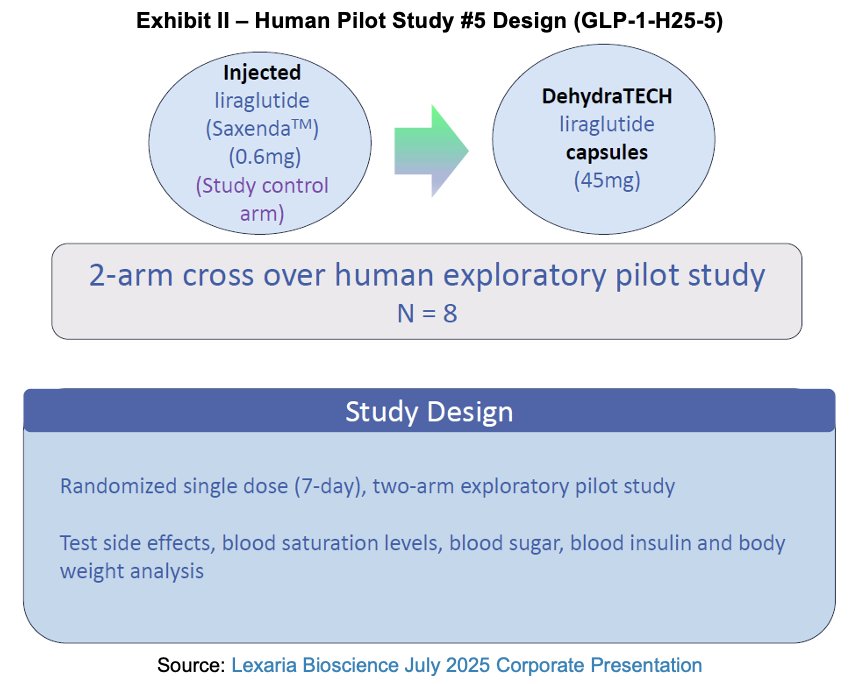
Lexaria completed its GLP-1-H25-5 study in June and reported initial safety data. GLP-1-H25-5 was a pilot, cross-over investigation of 10 overweight volunteers administered oral DehydraTECH-liraglutide and Saxenda (injected liraglutide). The study had two objectives to determine if:
- DehydraTECH (DHT) processing would produce an oral version of liraglutide comparable to Saxenda
- The 505(b)(2) pathway is appropriate
GLP-1 Agonist Work
Over the last two years, Lexaria has evaluated the three leading Glucagon-Like Peptide-1 (GLP-1) agonists that are widely used for treating diabetes and weight loss. This includes liraglutide in the study referenced above as well as semaglutide and tirzepatide, which were evaluated in the GLP-1-H24-4 and GLP-1-H24-3 studies. With seven preclinical and clinical studies evaluating DHT, Lexaria has demonstrated improved performance from the technology and is seeking an established pharmaceutical partner to fund further clinical trials. The partnership would support a filing of a new drug application (NDA) leading to approval of a GLP-1 agonist-DHT oral formulation.
GLP-1-H25-5 Safety Data
In its June 11th press release, Lexaria provided adverse event (AE) safety data for the DHT and Saxenda arms of the trial. To place the data in context, it is necessary to understand the source of the AEs. A blood draw was required to evaluate drug performance and safety according to the trial protocol. Four AEs related to the blood draw in the DHT arm and one AE in the Saxenda arm were recorded. Since the blood draw was related to the trial and not the administration and effect of the drug, we exclude the blood draw-related AEs in the next paragraph’s safety comparison.
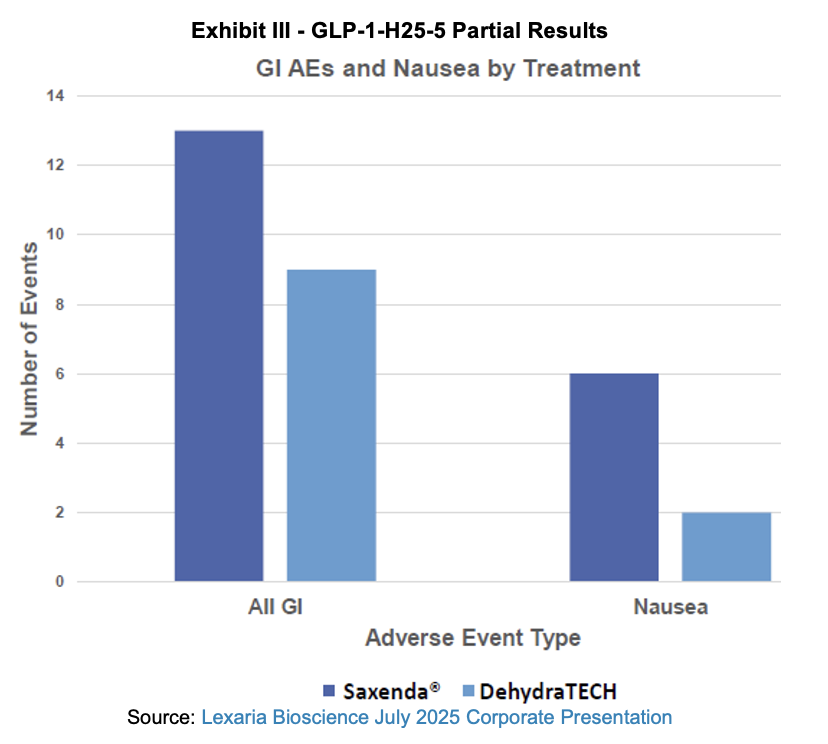
Ignoring the blood draw’s impact, the DHT arm produced 17 AEs compared to 22 in the Saxenda arm. This shows a 22.7% lower relative incidence of AEs.[4] Specifically, nausea was 67% lower and gastrointestinal events were 31% lower in patients administered the DHT formulation. There were no statistically significant differences in blood glucose, insulin, and body weight across most time points between the two arms. Weight loss was achieved by 9 of 10 subjects with the magnitude of weight loss characterized as “slightly higher” in the Saxenda study arm. However, weight loss was not a primary goal of this short-duration study. The small sample size prevents the study from generating statistically significant results and readers should be cautious in overestimating the reliability of the findings. However, in context with the other studies run, these results provide additional confidence of the improved tolerability of the DHT formulation.
SUBSCRIBE TO ZACKS SMALL CAP RESEARCH to receive our articles and reports emailed directly to you each morning. Please visit our website for additional information on Zacks SCR.
DISCLOSURE: Zacks SCR has received compensation from the issuer directly, from an investment manager, or from an investor relations consulting firm, engaged by the issuer, for providing research coverage for a period of no less than one year. Research articles, as seen here, are part of the service Zacks SCR provides and Zacks SCR receives payments totaling a maximum fee of up to $50,000 annually for these services provided to or regarding the issuer. Full Disclaimer HERE.
________________________
[1] Aroda, V.R. et al. A new era for oral peptides: SNAC and the development of oral semaglutide for the treatment of type 2 diabetes. Reviews in Endocrine and Metabolic Disorders. October 2022.
[2] Husain, M. et al. Oral Semaglutide and Cardiovascular Outcomes in Patients with Type 2 Diabetes. New England Journal of Medicine. June 2019.
[3]Novo Nordisk R&D Investor Event, June 22, 2025
[4] Including the AEs related to the peripheral intravenous line used for blood sampling, DHT produced 21 AEs while Saxenda produced 23.