
Since the beginning of the Industrial Revolution, people have looked to the sea as a potential source of nearly unlimited, sustainable energy that rolls by our coasts every day in the form of wave energy. As early as the 19th century, inventors began devising plans to harness this energy to power early mechanical devices inside mills, water pumps, and later, even small electrical systems. However, despite the tantalizing appeal of this resource, wave energy has yet to be fully developed into a viable commercial alternative to mainstream renewable energy sources like wind and solar.
The current global power demand forecasts, which indicate sharply higher energy needs in all corners of the planet, are sparking renewed interest in all forms of sustainable power, including wave energy conversion. Nuclear energy is again in vogue, support for onshore and offshore wind continues to grow outside of the U.S., and large, utility-scale solar farms have become the norm. The knock-on effects include interest in emerging energy-generating technologies, such as wave energy conversion.
Experts predict a 50-75% increase in global energy demand by 2050, primarily due to emerging market economic growth, population growth, and the widespread adoption of technologies that will require more electricity, including increased EV penetration rates and AI-driven data center growth. While much of this demand will be met with existing renewable energy solutions, the needs are so significant that wave energy is again drawing strong interest. Wave energy is appealing due to its proximity to large population centers (typically along the Western coasts), the fact that this sustainable resource remains largely untapped today, and its ability to generate electricity locally in remote locations.
The Problem: Sustainable Energy Needed Near and Far
Despite shifting political priorities that have slowed efforts to limit emissions, particularly in the United States, many nations and voting blocs (notably the EU) are continuing to strive to meet the growing demand for power with technologies that move them toward their net-zero emission targets. In fact, in July 2025, the European Commission indicated that member states should target 5% of newly installed renewable energy capacity be innovative, and ocean energy is one of just two technologies that count as innovative renewable solutions currently available to meet this goal.1
The most widely adopted sustainable energy systems, wind and solar, have seen their technologies mature significantly over the past decade, resulting in improved economic feasibility relative to traditional fossil fuel energy sources. Additionally, societal preference for sustainable energy has grown sharply around the world over the past two decades, fueling demand for sustainable options. However, despite the significant strides made in the solar and wind industries, they still face challenges associated with the intermittent nature of their production.
In contrast, ocean waves can be predicted with some degree of accuracy in advance based on storm patterns, and waves are in motion nearly perpetually. While wave energy conversion cannot be viewed as a source of baseload energy like fossil fuel energy systems or nuclear energy, some industry experts believe that when placed in the right geographic areas, wave energy could be a sustainable solution that can be a key component of a comprehensive approach to energy generation.
Given that waves tend to be stronger in winter months when solar generation is lower due to increased cloud cover and reduced solar radiation, wave energy is seen as a complementary source to solar systems. Also, large swell waves tend to peak before and after storms move through an area, which means that the wave energy and wind energy systems working in concert could provide a more consistent level of energy.
A report published by the Blue Economy Cooperative Research Centre found that wave energy decreases the cost of reaching a guaranteed power supply level. As part of a renewable system, wave energy can reduce the need for other energy storage solutions.2
However, despite all this promise and the strong push to curb emissions worldwide over the past decade, it must be acknowledged that the industry has not yet realized its full potential. The technical challenges of operating in harsh ocean conditions have been more difficult than initially envisioned. A secondary factor that has slowed the adoption of wave energy conversion technology is simply that wind and solar energy have become ubiquitous, affordable, and reliable.
While the wave energy industry remains promising, the focus of deployments for many companies has recently shifted from attempting large, utility-scale installations to providing unique applications of the technology that reduce reliance on fossil fuels. Bringing sustainable energy solutions to remote communities where wind and solar options are not ideal, or to offshore production barges that currently rely on diesel generators, may be smaller markets than initially imagined by wave energy proponents; however, it presents a very real opportunity that may accelerate the commercialization of the technology.
Carnegie Clean Energy
Carnegie Clean Energy (OTCQB:CWGYF) has a long operating history, having been founded in the 1980s to harness the energy of ocean waves. The company has refined its approach with each successive generation of its CETO technology. The company’s latest solution has leveraged the knowledge and experience gained from operating its previous system for over 14,000 hours.
CETO – Carnegie first deployed their 5th-generation system in 2013 with three units, and one of the units delivered more than 10,000 hours of continuous use during testing. The company’s new 6th-generation design is a fully submerged point absorber wave energy conversion solution. The full-scale CETO system will be a 20-meter-diameter submerged point absorber placed in water at least 40 meters deep, located within 1 to 10 kilometers of the shore. The system’s design utilizes all aspects of a wave’s motion – the heave (vertical lift), the surge (horizontal movement), and the pitch (circular motion)- which should capture a greater portion of a wave’s total energy. The company has indicated that the latest CETO design will have a 1 MW output per unit, which is expected to be roughly four times the output of the company’s older designs. Carnegie envisions installing many CETO platforms together to create a substantial energy generation facility.
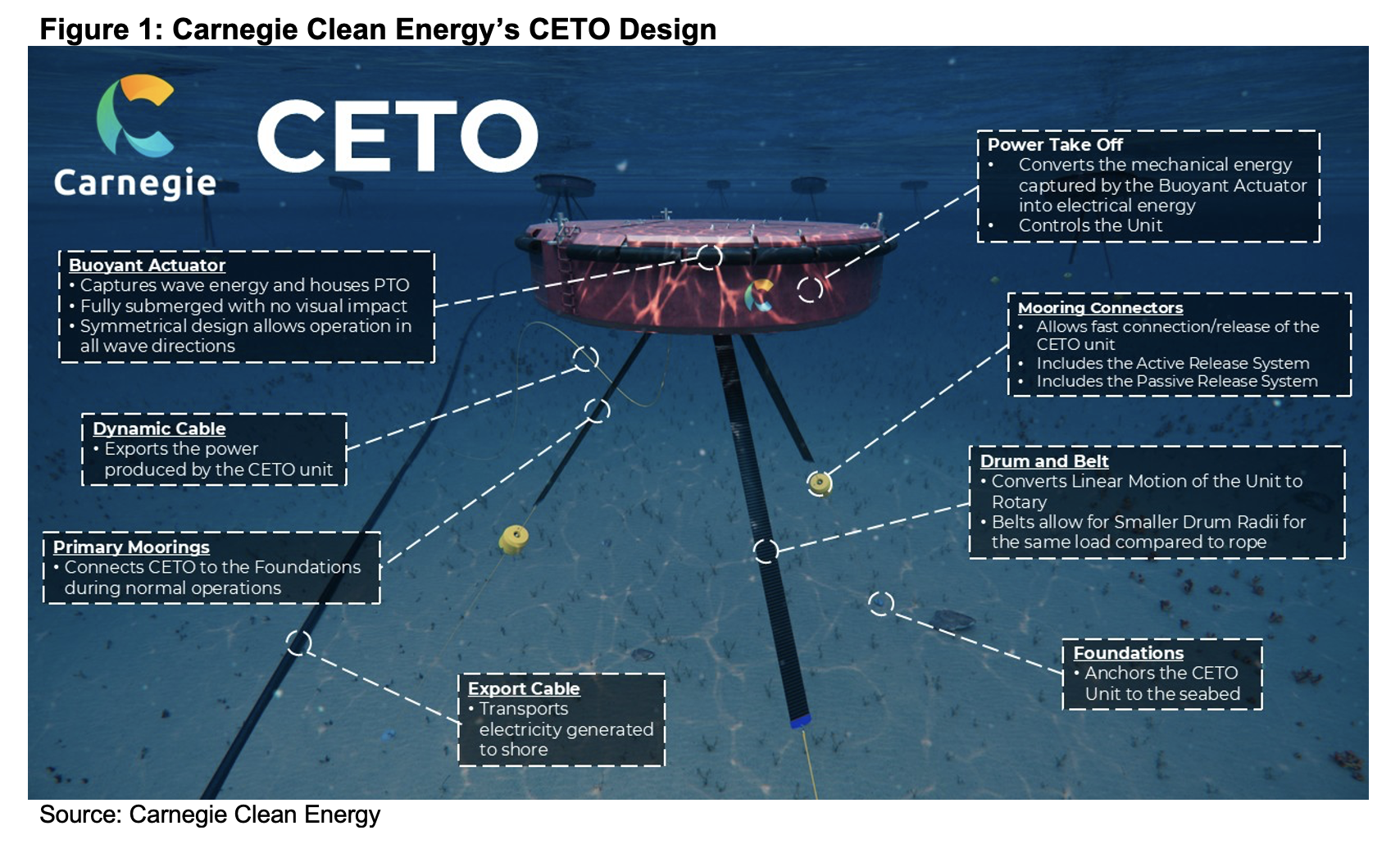
The designs published in the company’s latest mockups show the mooring connections anchored to the seafloor via a belt that rolls across spinning drums that are connected to three generators in the unit. As the belt spins, the drums in turn rotate the generators to create electricity driven by the movement of the ocean. The Power Take Off units include an electrical drive train (a gearbox coupled to a generator) and a tensioner that are maintained in sealed, dry compartments on the unit. The company now utilizes an “umbilical” tether that is capable of withstanding the motion of the buoy and any disturbance in the water column to bring electricity to shore.
By operating the CETO at a depth of roughly 2-3 meters beneath the ocean surface and with the ability to adjust its position, Carnegie’s management believes that the system will be less likely to experience damage from extreme weather conditions that have plagued many early wave energy systems. The CETO can adjust its position and depth in the water column, which reduces the system’s exposure to large storm waves while still allowing the system to generate electricity, unlike many competing solutions that are unable to operate in extreme weather conditions.
The company began developing the latest CETO design nearly a decade ago and has funded the project’s development through a combination of grants from the Australian Renewable Energy Agency and loans from financial institutions. Progress was severely impacted by the company’s voluntary administration in 2019; however, a recapitalization effort led to AUD 5.5 million of new investment in the company in 2019, which allowed the company to re-list on the Australian Stock Exchange and refocus on efforts to commercialize its CETO technology.
MoorPower
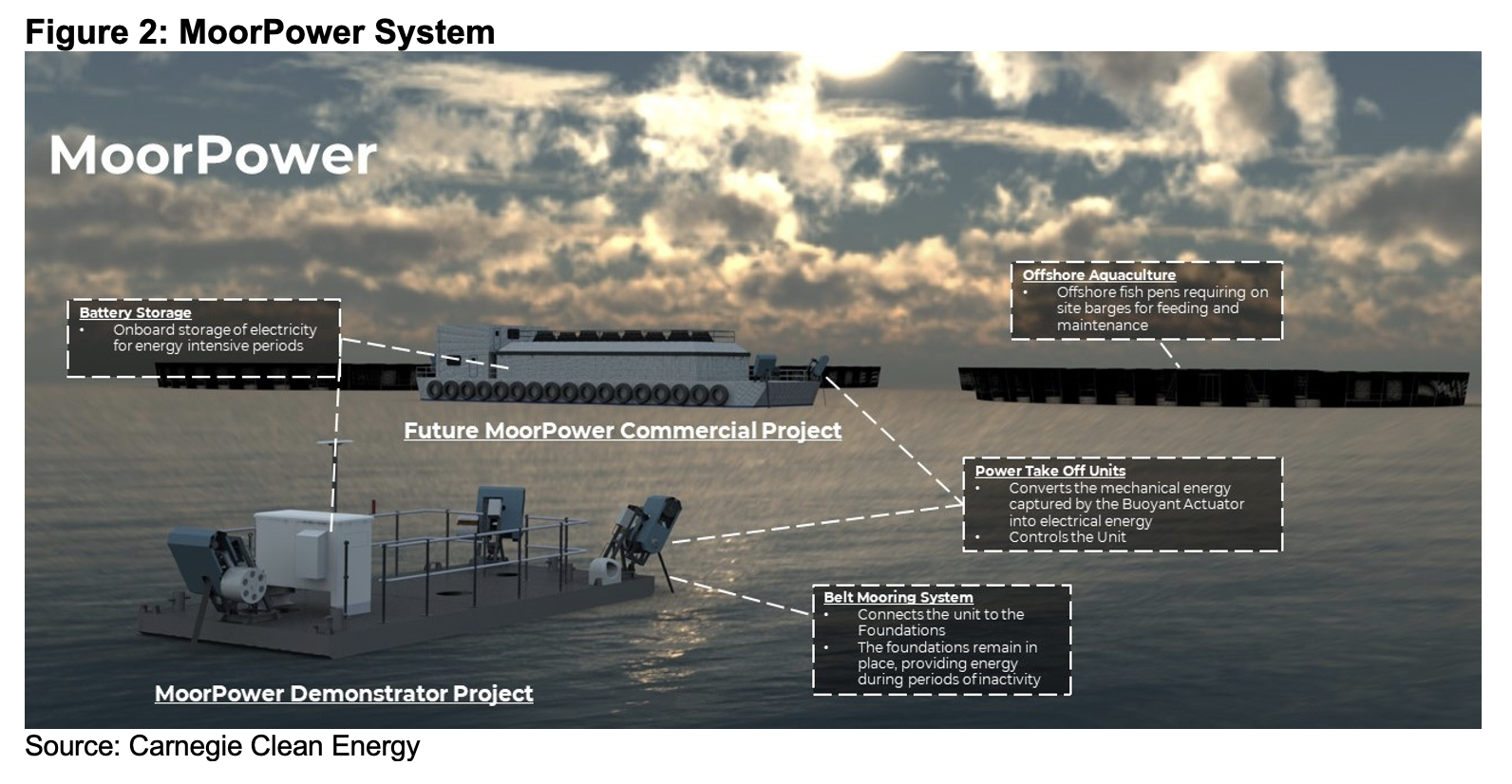
The company has also applied the core principles of its CETO technology to develop a wave converter system designed to generate electricity specifically for offshore energy needs.
In particular, the company is targeting the energy needs of aquaculture barges that require electricity for controlling automated fish feeders, platform lighting, circulation pumps, and potentially refrigeration of harvested fish. These barges are often located in remote corners of the world’s oceans and primarily rely on diesel generators to meet most of their basic energy needs. Some companies that operate these barges have begun transitioning to a combination of solar and battery backup systems to reduce their reliance on diesel generators and lower the carbon footprint of their operations, demonstrating the industry’s commitment to sustainability. The power needs of the barges can be quite substantial, however, and the prospect of having 500-1000 solar panels connected to a barge in the open ocean is daunting.
Carnegie deployed a scaled demonstrator barge project in Western Australia, which consisted of three power take-off units connected to the ocean floor, enabling the barge to generate electricity as it moved with the waves. The scaled demonstrator project was completed in 2024. The company is collaborating with barge owners and its commercial partners to bring its design to market within the next couple of years.
In June 2025, Carnegie Clean Energy announced that the Blue Economy Cooperative Research Centre had awarded AUD 335,200 to Carnegie to deliver a preliminary design for a commercial MoorPower System. The company is working with several partners in the aquaculture industry and the University of Tasmania to provide this design.
Carnegie Project Portfolio
1. CETO – Carnegie Clean Energy is building an operational CETO wave energy converter in Bilbao, Spain, at the Biscay Marine Energy Platform (BiMEP), which it refers to as CETO ACHIEVE.
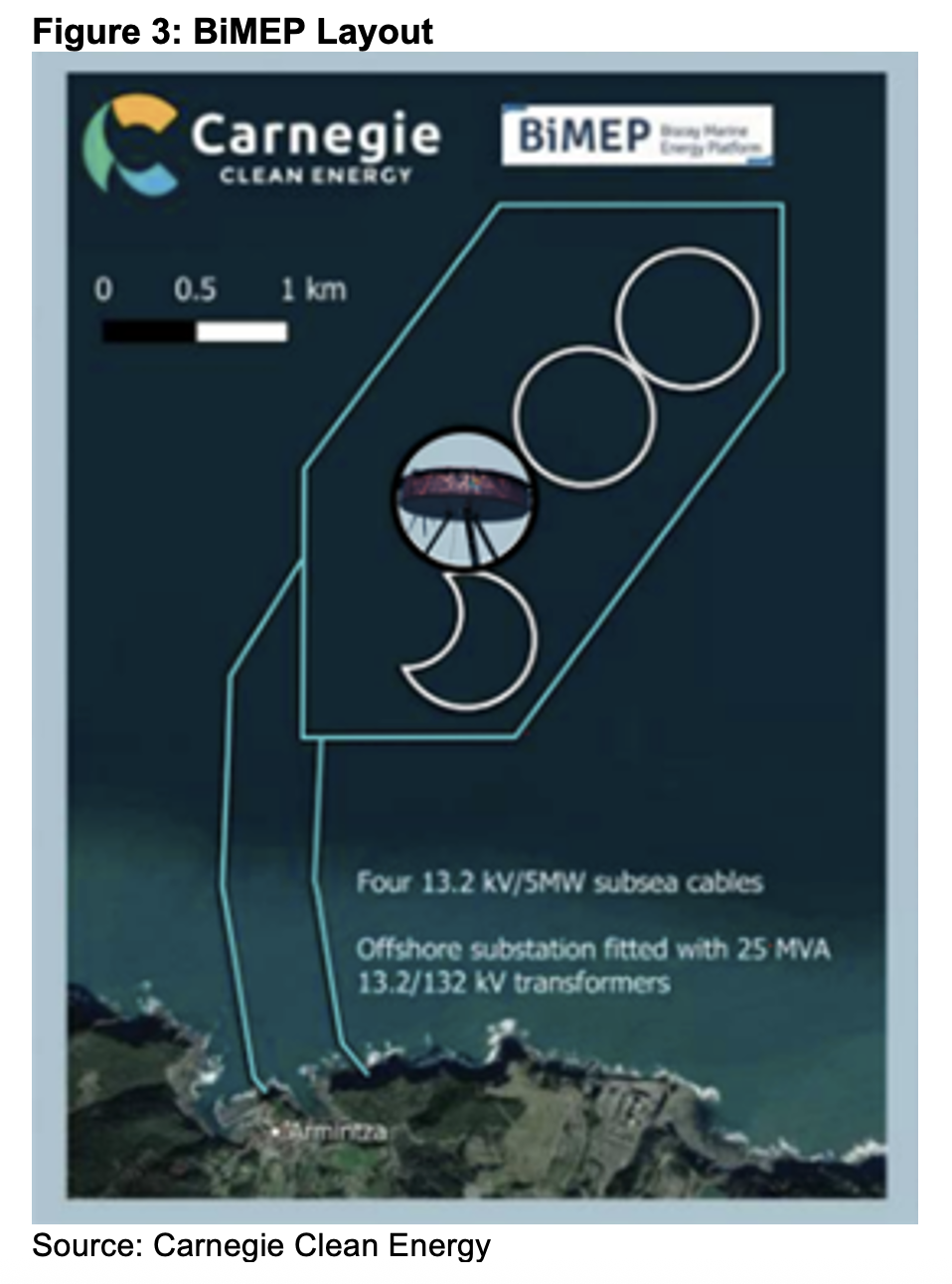
The EuropeWave Pre-Commercial Procurement Programme selected Carnegie as one of three contractors to deliver advanced wave technologies in Europe and provided the company with 3.75 million euros. The Spanish marine initiative, Renmarinas Demos, provided an additional 1.2 million Euros. Finally, the Basque Energy Agency provided 2.1 million Euros through its ACHIEVE+ program, which supports the local development of key technologies.
The EuropeWave award will fund the development of a scaled prototype of the company’s CETO wave energy converter and its deployment in the ocean. The company stated that during the bidding process, its Irish subsidiary, CETO Wave Energy Ireland, received the highest score from EuropeWave for its design. The awarding of Phase 3 funding for the project followed previous awards to deliver a tank test module and designs for sites in Scotland and the Basque Country. Phase 3 of this project is scheduled to run through May 2026.
In May 2025, the company announced that it had contracted with Swedish manufacturer SKF to produce three power take-off units for this project.
2. MoorPower Scaled Demonstrator – Carnegie began this project in 2021 to install and operate a scaled demonstrator of its MoorPower system offshore from the company’s research facility in North Fremantle, Western Australia. This project received AUD 3.4 million to demonstrate that it can provide clean, reliable energy to offshore operators that have historically relied on diesel generators. The project was completed in 2024.
3. Alaskan MOU – In May 2025, the company announced that it had signed a memorandum of understanding (MOU) with the Alaskan non-profit agency Chugachmiut. The three-year MOU will allow Carnegie to explore areas that could be candidates for the company’s CETO technology along the Alaskan coast. No financial terms were disclosed.
The Wave Energy Industry: Untapped Potential
Energy experts highlight the potential of the world’s oceans for delivering clean, consistent, sustainable energy but commercialization of technologies to tap that energy has been slower than anticipated as a result of the relatively high build out costs, high operating costs, unanticipated challenges of operating in the open ocean and the proliferation of solar and wind technologies over the past decade that have significantly aided decarbonization efforts. While research and financial resources continue to flow into the wave energy industry, no single wave technology has yet proven to be superior to other approaches.
Recently, many industry participants have begun to coalesce around the idea of deploying targeted wave energy solutions for:
- isolated regions of the world, like remote coastal or island communities
- offshore industries, such as drilling rigs or aquaculture applications.
- Colocation opportunities with offshore wind farms
The leading wave energy companies generally utilize one of the following core technologies:
Point Absorbers that move with waves but are attached to a fixed structure (like the ocean floor) and tend to be buoys, floating platforms, or, in the case of the CETO system, a submerged buoy. Floating-point absorbers are typically used in regions with regular wave patterns, which allow for efficient wave energy capture. However, floating point absorbers are more exposed to ocean elements (weather and surface ocean debris) and have a greater impact on sightlines, which may be considered a drawback for systems placed near a shoreline.
In contrast, submerged point absorbers do not impact the view from shore and are less prone to damage during storms. However, they tend to absorb less power than surface buoys, and maintenance is more challenging because repairs must be completed underwater.
Attenuators float on the ocean surface and consist of multiple connected segments that “ride” waves as they pass. The flexing movement of the devices as the wave passes can be used to drive hydraulic pumps or a rotating turbine to generate electricity. Like floating point absorbers, attenuators face challenges associated with harsh weather conditions on the ocean’s surface.
Oscillating Wave Surge Converters use flaps or large plates that are hinged to a fixed point (ocean floor or seawall) that move back and forth with the movement of the ocean waves to drive a hydraulic system.
Oscillating water columns mimic the blowholes found in nature and utilize the movement of waves to push air through a pressurized chamber, which can then spin an air turbine to generate electricity.
Each successive pilot project or large-scale installation in the wave energy conversion industry has furthered understanding of the challenges of operating in complex environments like the open ocean. However, when compared to other energy technologies, the high levelized cost of energy for wave energy remains a significant obstacle preventing broader adoption.
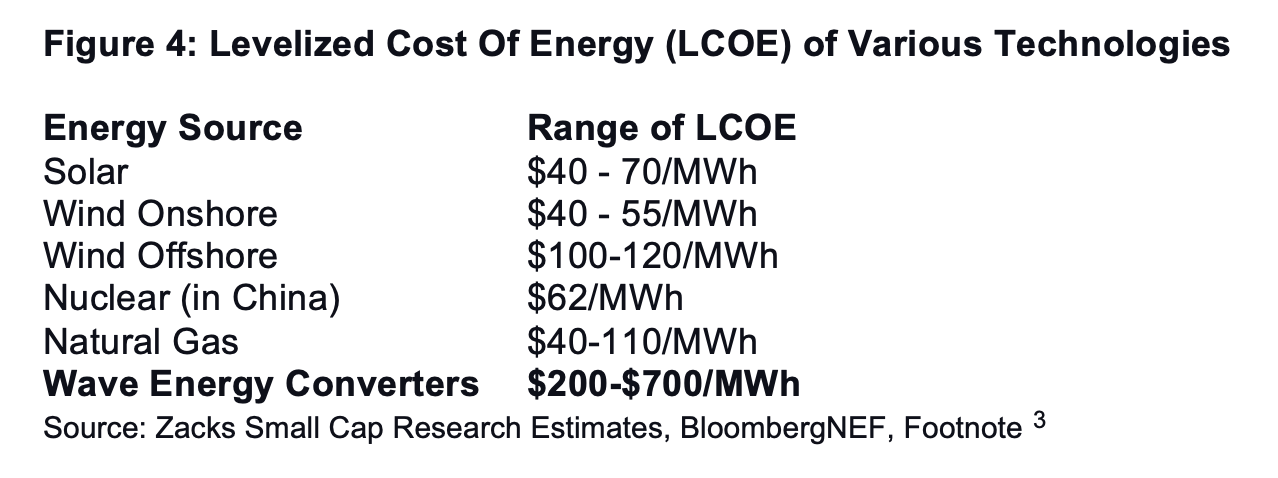
The lack of any true utility-scale wave energy conversion systems, limited deployments around the globe, and the absence of economies of scale at this point suggest that wave energy is not competitive with other renewable solutions on a cost basis. Since 2010, a total of just 27 MW of wave capacity has been installed, while the wind and solar industries have each added over a Terawatt (1,000,000 MW) of capacity.4
However, it is worth noting that a little over a decade ago, solar energy had a levelized cost of energy exceeding $400/MWh. As a result of steady investment, technological advances, and large-scale deployments, the price has dropped by over 80% in the past decade. It is unclear whether wave energy can achieve similar efficiencies in the coming decade, but it is encouraging that there is a precedent for new technologies to successfully reduce the cost of energy production as the industry matures.
A recent study by LUT University and Delft University indicated that by 2035, the LCOE of wave energy converters could fall to roughly $70/MWh, which would make it very competitive with many alternatives today.5
Positive Industry Tailwinds
Despite the slow rollout of wave energy conversion technology compared to other renewable technologies and high-profile project failures in the industry, several positive trends are emerging that should support renewed interest in wave energy.
Decarbonization goals – Although decarbonization is not a Federal priority in the U.S. at present, many multinational companies remain committed to the concept and will continue to explore technologies that help them meet their goals. In Europe, the European Commission recently renewed the EU’s commitment to reduce carbon emissions by 90% by 2040. The latest EU legislation allows countries to meet their decarbonization goals through projects based outside the EU, which could spur investment in areas where wave energy has strong potential, such as Australia or Chile.
High energy density and predictability of wave energy – While solar and wind energy companies have improved models for addressing changing weather patterns, there remains a fair amount of uncertainty when it comes to those sources of energy. In contrast, wave energy (particularly at latitudes between 40 and 60 degrees North and South) remains very predictable.
Offshore wind – Installed capacity of offshore wind grew to 83 GW in 2024 but is forecast to grow by another 350 GW over the next decade.6 Co-locating wave energy systems with offshore wind farms offers many potential benefits, including a reduction of energy variability (wave energy tends to peak before and after storms that often spike wind farm output) and cost savings by using the same grid connections, substations, or cabling and shared maintenance programs.
Horizon Europe – This EU program has allocated 120 million Euros for funding wave energy research and development. This seed capital should foster larger wave energy conversion projects in Europe.
Challenges Facing the Industry
Past failures: Over the past decade, several high-profile attempts to launch wave energy companies have failed due to the significant financial and technical challenges of operating a system in the open ocean. All things being equal, investors, corporate buyers, and governments are much more willing to take a chance on proven technologies like solar or wind. This has left a significant gap in the market for financing projects in the wave energy industry, which must be filled primarily through special-purpose public funds, such as the Horizon Europe initiative.
Costs: Currently, wave energy is not cost-competitive with other renewable energy solutions, with a levelized cost of energy that is 3-10 times higher than that of most other renewable energy sources. This presents a bit of a chicken-and-egg problem for the industry, as costs won’t decline until more systems are deployed, but more systems won’t be deployed until the costs fall. We are encouraged by efforts in the EU to maintain commitments to carbon reduction, which will lead to greater renewable investments, even in technologies with a higher LCOE, as this may ultimately result in lower costs across the industry.
Operating in harsh environments: The reality for wave energy companies is that the systems they deploy must operate in corrosive saltwater, which often leads to the faster deterioration of key mechanical parts, and frequent rough seas, which can damage equipment. Replacing or repairing any parts on a wave energy system requires specialized contractors capable of working underwater, which can significantly lengthen repair times and increase the cost of repairs and maintenance compared to other renewable technologies.
Renewable push back in the U.S.: While this trend is likely to ebb and flow with the changing political climate in the U.S., the current shift in the U.S. away from advancements in renewable energy and a possible return to a greater reliance on fossil fuels is certainly a negative for investors in renewable technology, including wave energy systems. The current 2026 U.S. Federal budget sharply reduces or eliminates support for several renewable sectors. While wave energy conversion has not been specifically mentioned, the targeting of offshore wind initiatives for elimination will remain a cloud hanging over the industry in the U.S.
However, despite the current political climate in the U.S., the potential of wave energy conversion may be simply too large to ignore, given the growing U.S. power demand in the coming decades. States along the West Coast (Alaska, California, Oregon, and Washington) could host wave energy systems, and the political climate in these states is more favorable to renewable energy solutions than the current Federal government. According to a 2021 U.S. Department of Energy Report, up to 23% of California’s energy needs could be met by capturing the wave energy that reaches the state’s 840 miles of coastline.7
We believe that in the race to meet the electricity needs of consumers and corporations, states will look to unlock the potential of local renewable resources regardless of support from the U.S. Federal Government. Consider, for example, in 2005, Iowa met just 3% of its electricity needs with the ample wind that blows across the state, but by April 2025, the state met 76% of its electricity needs with wind resources.8
We feel that the success of wind adoption in Iowa is a good example of the sort of deployment that could occur for wave energy solutions in states along the West Coast of the U.S. over the next two decades.
Other considerations
Shares of Carnegie Clean Energy are listed on the Australian Securities Exchange (ASX:CCE.AX), where they experience strong trading volumes, averaging over 200,000 shares per day. The company’s shares are also listed on the OTCQB “venture market” in the U.S. (OTCQB:CWGYF). The OTCQB shares have significantly lower trading volumes, and as a result, they are more prone to wide daily swings in share price due to their lower volumes and wider spreads.
Conclusion
Carnegie Clean Energy (OTCQB:CWGYF) has a long development history of its wave energy conversion technology, dating back to the 1980s. The company’s two products – CETO, a submerged point absorber wave energy conversion system, and MoorPower, a barge-based solution for energy generation for offshore operations – continue to move toward full commercialization. To our knowledge, there are only a handful of publicly traded pure-play wave energy companies, which means that investors with a focus on the sustainable energy space should keep Carnegie on their radar.
________________________
2 https://blueeconomycrc.com.au/project/ocean-wave-energy-in-australia/
3 https://docs.nrel.gov/docs/fy25osti/91775.pdf
4 https://www.ren21.net/gsr-2024/modules/energy_supply/02_market_and_industry_trends/06_oceanpower/
7 https://www.energy.gov/sites/default/files/2021/02/f82/78773_3.pdf
8 https://www.chooseenergy.com/data-center/wind-generation-by-state/