READ THE FULL AZTR RESEARCH REPORT
Azitra, Inc. (NYSE:AZTR) reported second quarter 2025 results in an August 11th press release sharing financial results and providing a business update. Since our previous quarterly update in May, Azitra has announced safety results and 50% enrollment for its Phase Ib program of ATR-12 in Netherton syndrome. It also presented a poster at ASCO on EGFRi associated rash. In the financial sphere, the company signed an agreement with Alumni Capital providing up to $20 million in an equity line of credit. Looking ahead, management expects to share topline efficacy results from the Netherton trial in 1Q:26 and to dose the first patient in the Phase I/II ATR-04 trial in the next few weeks.
Operational and Financial Results
Azitra reported 2Q:25 results in a press release and Form 10-Q filing with the SEC on August 11th. For the quarter ending June 30th, 2025 and versus the prior year’s comparable period, no revenues were reported. Net loss for the three-month period totaled ($2.9) million or ($1.18) per share.[1] Operational expenses rose 8% as increases in research and development (R&D) expenses were only partially offset by lower general and administrative (G&A) outflows. Below, we detail financial results for 2Q:25, compared to the same prior year period:
- Research and development expenses increased by 25% to $1.4 million from $1.1 million stemming from greater clinical trial costs for the ATR-12, ATR-04 and ATR-01 programs, increased payroll costs due to raises and additional headcount and more lab supplies partially offset by lower clinical consultant expenditures;
- General & Administrative expenses totaled $1.5 million, down 5% due to lower financing, accounting, insurance and conference costs;
- Net interest income was $15,000 compared to $14,000;
- Other expense was ($33,000) compared with $13,000 with the difference due to loss on foreign currency;
- Net loss was ($2.9) million or ($1.18) per share vs. ($2.6) million;
As of June 30th, 2025, cash totaled $1.0 million. This amount compares to the $4.6 million balance in cash held at the end of 2024. No debt was held on the balance sheet. 1H:25 cash burn was ($5.9) million, slightly greater in magnitude than the ($5.3) million consumed in 1H:24. Cash from financing was $1.2 million representing proceeds from public offerings and the equity line of credit with Alumni Capital. We expect that Azitra will regularly access the equity line to continue funding the pipeline. Post quarter end, Azitra raised ~$900,000 with the facility.
Corporate Update with Azitra COO Travis Whitfill
ATR-12 Clinical Trials
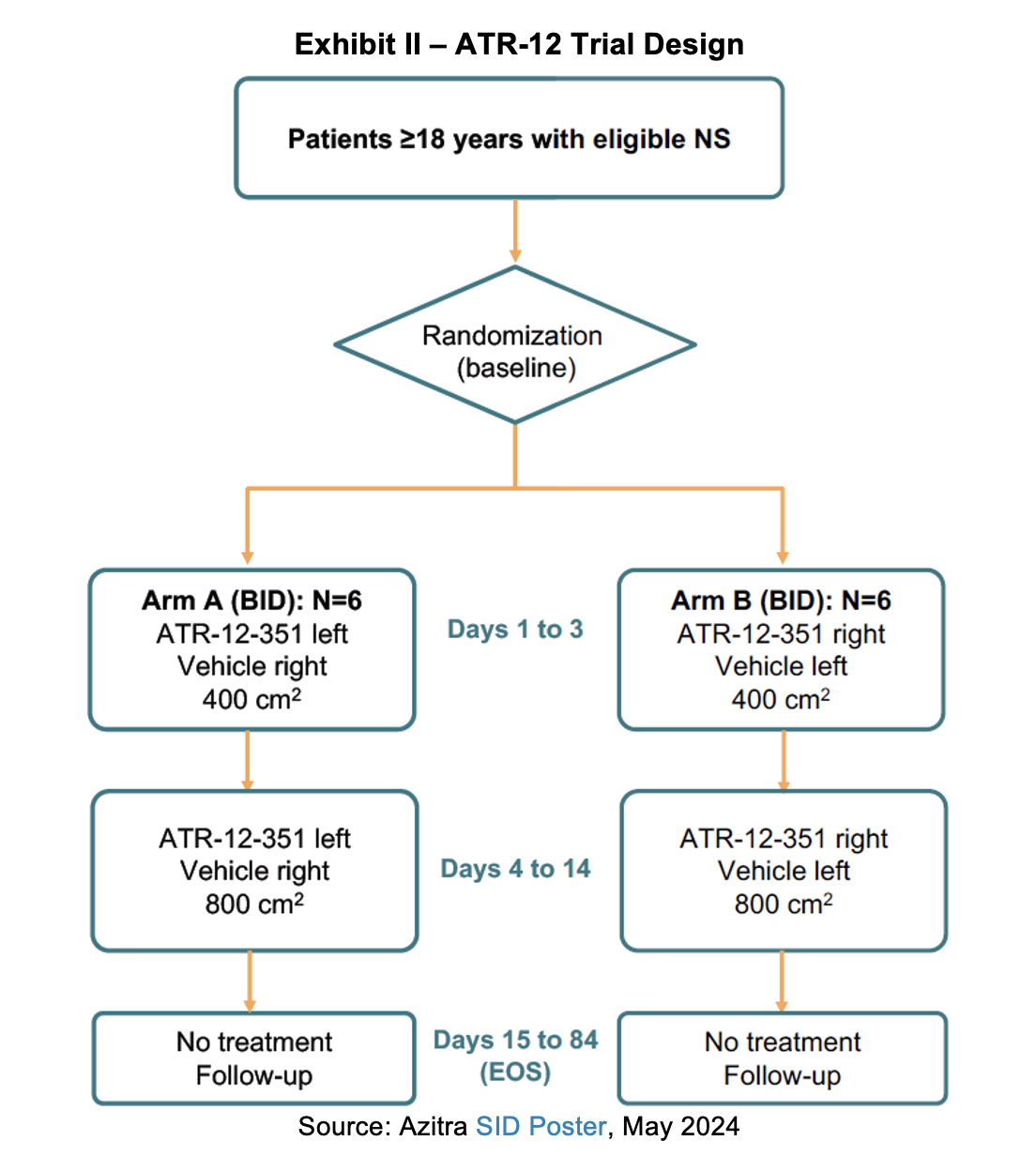
Azitra received investigational new drug (IND) clearance for its Netherton syndrome candidate, ATR-12, in January 2023. The company has since launched a Phase Ib clinical trial under the identifier NCT06137157 and expects to enroll 12 patients. As of mid-June, the trial is 50% enrolled. Primary endpoints will examine safety and tolerability while secondary and exploratory endpoints will assess efficacy signals and biomarkers. ATR-12 will be topically administered twice daily. Clinical sites at Yale University and Stanford University have been established.
June 2025 Interim Update
In an interim update, the Phase Ib trial reported safety data in a June 17th press release. There have been no reports of severe or serious adverse events in the ongoing clinical trial. Application site reactions have been transient and self-resolving and included mild to moderate localized itch, redness, and a burning sensation with application. Such reactions have been observed bilaterally, suggesting this is not a drug effect. The trial remains blinded, and data regarding the effect of the drug is not yet available.
ATR-12 Trial Details
The study will apply ATR-12 to lesions on one side of a subject’s body and apply the vehicle to the other. Application of ATR-12 and the vehicle will be performed twice daily for two weeks. Patients will be randomized to receive ATR-12 on either the right or left side. Initially, the FDA required that patients be dosed one at a time and sequentially to provide an initial safety profile before allowing parallel enrollment. Azitra has since crossed this hurdle and had enrolled six patients as of mid-June 2025, achieving 50% of target enrollment. Two sites are active. One at Yale University and the other at Stanford in Northern California. The study requires that the young patients stay at the location for two weeks for treatment.
The primary endpoint is adverse events at 84 days as well as quantifying and qualifying incidence, severity, seriousness and relatedness of adverse events. Secondary endpoints include investigators’ and patients’ global assessment of severity, concentration of recombinant human lymphoepithelial Kazal-type related inhibitor (rhLEKTI) in the plasma and on the skin following topical application. Biomarkers will be evaluated including KLK5, KLK7, IL-36, TARC/CCL17, trypsin-like activity and chymotrypsin-like activity.
ATR-04
Epidermal growth factor receptor inhibitors (EGFRi) are targeted cancer therapies that have been effective in breast, colon, lung and pancreatic cancer. EGFR is a protein found on the surface of cells, and it plays a role in cell growth and division. In some cancers, such as certain types of lung cancer and colorectal cancer, the EGFR gene is mutated or overexpressed, leading to uncontrolled cell growth. EGFR inhibitors work by blocking the activity of this protein, thereby slowing or stopping cancer cell growth.
In the skin, EGFR regulates multiple keratinocyte functions including proliferation, adhesion and migration, survival, and differentiation. Consequently, inhibition of EGFR in the skin results in adverse skin reactions, which make it difficult for patients to continue therapy. Two of the leading EGFR inhibitors, erlotinib and gefitinib, carry FDA labels that warn of rash and skin reactions in over 20% of patients. In many cases it is severe enough for the individual to stop EGFRi therapy. The skin reaction, which is referred to as an acneiform or papulopustular rash, can vary in intensity. Mild rash is treated with topical medications and oral antibiotics; however, in severe cases a doctor may stop treatment.
The side effect is an unmet need that may be addressed using ATR-04, which is a genetically modified strain of S. epidermidis. The strain demonstrated properties of inhibiting IL-36γ, S. aureus and related biofilms. ATR-04 has been modified to be auxotrophic for D-alanine. The product is formulated as a topical application and may also help reduce the use of antibiotics, allow for better compliance with EGFRi regimens and improve patient quality of life.
Preclinical work for ATR-04 was completed and assembled with other required data into an investigational new drug (IND) application submitted last summer to the FDA. In an August 22nd press release, Azitra announced that the IND had been cleared which allows the company to begin its Phase I/II study of ATR-04 for moderate to severe EGFRi associated dermal toxicity. In September, the FDA granted Fast Track Designation to ATR-04 for Azitra’s indication.
A Phase I/II is now planned to start in 3Q:25 that will enroll eight patients in a single ascending dose Phase I study over 28 days. The Phase II portion will target 24 patients for this segment of the study. A contract research organization (CRO) is in place and four sites across the US are being identified for use. Azitra anticipates a rapid enrollment as these are high volume cancer centers with many potential candidates receiving EGFRi treatment.
SUBSCRIBE TO ZACKS SMALL CAP RESEARCH to receive our articles and reports emailed directly to you each morning. Please visit our website for additional information on Zacks SCR.
DISCLOSURE: Zacks SCR has received compensation from the issuer directly, from an investment manager, or from an investor relations consulting firm, engaged by the issuer, for providing research coverage for a period of no less than one year. Research articles, as seen here, are part of the service Zacks SCR provides and Zacks SCR receives payments totaling a maximum fee of up to $50,000 annually for these services provided to or regarding the issuer. Full Disclaimer HERE.
________________________
[1] We update per share amounts in this report to reflect the 15:100 reverse stock split that took place on August 21st, 2025.