
Following our recent initiation of coverage for Actinium Pharmaceuticals, Inc. (NYSE: ATNM), this research note provides life sciences investors with an introduction to the radiopharmaceutical industry. We examine the science, clinical applications and manufacturing requirements shaping the sector, highlighting both its therapeutic potential and the challenges of development and commercialization. The following pages complement our company-specific research and provide a foundation for evaluating Actinium and other radiopharmaceutical companies.
Radiopharmaceuticals are radioactive medicines or radioisotopes that are used to diagnose and/or treat disease. They are used to image a variety of conditions from cancer to cardiovascular disease to kidney dysfunction and neurodegenerative disease. They have also shown promise in conditioning prior to a stem cell transplant due to the precise delivery of radiation. In the treatment realm, this class of drug is predominantly used in cancer. Imaging has broader applications in oncology, neurology and cardiology. Radionuclides are radioactive forms of elements that can either occur naturally or be manufactured. The radioactive element contains an unstable nucleus which emits radiation as it decays. The particles and rays that it emits can either be detected by a variety of diagnostic devices or bombard tumors which causes DNA strand breaks and cancer cell death.
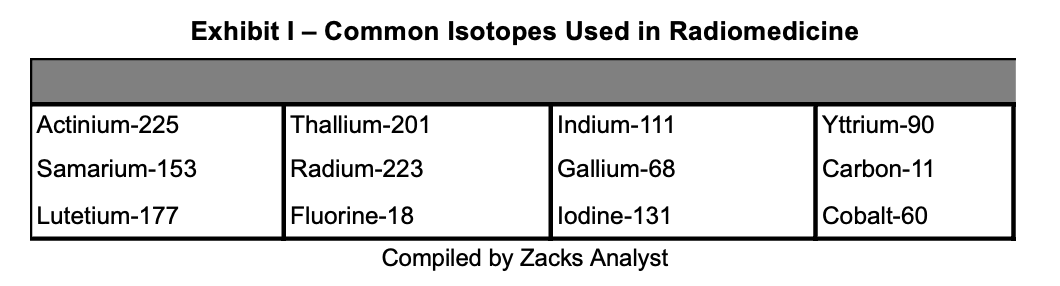
The agents can be further categorized depending upon what type of radiation they produce. These include products that release alpha (α) particles, beta (β) particles, gamma (γ) radiation, positrons and neutrons among other emissions. The emissions support applications in medicine, scientific research, industrial processes and energy production. Some of the most common radionuclides, which are also known as radioisotopes, are listed below.
The physical half-life[1] of a radioactive isotope is a critical consideration in the use, safety, and efficacy of radiopharmaceuticals. It determines which facilities can accommodate a given product and constrains which clinical applications are feasible. For diagnostic use, an isotope must have a half-life short enough to decay away soon after imaging is completed, whereas for therapeutic applications, the physical half-life must be long enough to fatally damage the cancer cells it seeks to eradicate. The biological half-life is another vital consideration. It is the time required for the body to eliminate half the agent through metabolism, excretion, and other physiological processes. Together, the physical and biological half-lives combine to yield the effective half-life, calculated as Te = (Tp × Tb) / (Tp + Tb),[2] which governs the elimination of radioactivity from the body. When estimating residual activity or performing radiation dosimetry calculations, the effective half-life is the most important value, as it accounts for both radioactive decay and biological clearance.
Radiopharmaceuticals undergo rapid decay and often must be prepared immediately before administration, placing operational demands on manufacturers, hospital pharmacies and nuclear medicine departments. This requires providers to balance limits on distribution range and scheduling flexibility against exposure to unnecessary radiation beyond the diagnostic or therapeutic window. From a patient safety standpoint, the radionuclide half-life of a diagnostic agent should ideally be as short as possible, since any radioactivity remaining after a scan has no diagnostic value and contributes only to patient radiation exposure. Radionuclide selection must be tailored to the specific clinical application, the logistics of delivery and the imperative to minimize patient risk.
Other features important to success include low cost and availability. The agent must specifically target the desired tissue but must either not accumulate in or clear quickly from non-target tissues in order to minimize background noise and organ exposure. The radionuclide should emit the proper type of radiation for its purpose, such as gamma rays for imaging and alpha or beta particles for therapy. Favorable pharmacokinetic properties are also essential such as effective targeting, stable labeling, predictable biodistribution, rapid clearance from non-target tissue and chemical stability.
SUBSCRIBE TO ZACKS SMALL CAP RESEARCH to receive our articles and reports emailed directly to you. Please visit our website for additional information on Zacks SCR.
DISCLOSURE: Zacks SCR has received compensation from the issuer directly, from an investment manager, or from an investor relations consulting firm, engaged by the issuer, for providing research coverage for a period of no less than one year. Research articles, as seen here, are part of the service Zacks SCR provides and Zacks SCR receives payments totaling a maximum fee of up to $50,000 annually for these services provided to or regarding the issuer. Full Disclaimer HERE.
________________________
[1] The half-life is the time it takes for half of any given amount of a radioactive isotope to decay into its daughter products. This rate remains constant regardless of the sample size.
[2] Te is effective half-life, Tp is physical half-life and Tb is biological half-life.