
READ THE FULL ABEO RESEARCH REPORT
Business Update
Zevaskyn Launch Continues Amidst Late-Stage Acquisition
Abeona Therapeutics, Inc. (NASDAQ: ABEO) reported third-quarter 2026 results highlighted by continued commercial progress for Zevaskyn, with net product revenue increasing 18% sequentially to $13.5 million. The company completed six patient treatments during the quarter, bringing the cumulative treatments since launch to 15, while expanding its qualified treatment center (QTC) network to eight locations. Although the commercial trajectory remains encouraging, the launch is still in its early stages, with patient identification, reimbursement authorization, manufacturing coordination, and treatment scheduling contributing to variability in quarterly results. In addition, the annual manufacturing facility shutdown will interrupt biopsy collections from mid-November through mid-January, creating a temporary headwind to the number of treatments that are possible in 4Q26 and 1Q27.
More significantly, Abeona announced the acquisition of ABO-801, a Phase 3-ready oral formulation of fluticasone propionate for eosinophilic esophagitis (EoE). The asset expands the company’s opportunity beyond rare genetic diseases into a substantially larger market, with approximately 360,000 diagnosed U.S. patients. While prior clinical studies demonstrated meaningful histologic and endoscopic activity, two completed Phase 3 trials failed to meet their prespecified co-primary symptom endpoints. Abeona plans to initiate another pivotal study in mid-2027, incorporating the validated Dysphagia Symptom Questionnaire (DSQ), with topline results potentially being available around year-end 2028. The acquisition provides a potentially meaningful second growth opportunity, although successful Phase 3 results remains the primary risk.
The company also recently secured $30 million through a private placement to strengthen the balance sheet, support continue Zevaskyn commercialization, and ABO-801 development.
Commercial Performance
Abeona generated $13.5 million in net Zevaskyn revenue during 3Q26, representing an 18% increase from $11.4 million in 2Q26. Six patients completed treatment during the quarter, bringing cumulative treatments since launch to 15. Revenue was recognized for five of the six treatments, as one manufacturing batch failed to meet the required pan-cytokeratin (pan-CK) identity assay release specification. The result demonstrates continued expansion of commercial activity, although the relatively small treatment base at present means that individual manufacturing outcomes can have an outsized impact on reported revenue and gross margin.
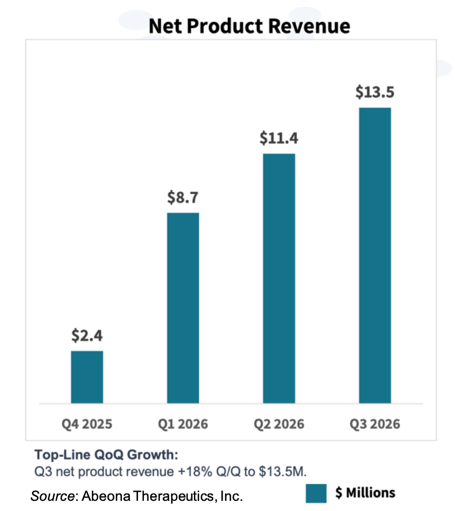
Recognized revenue averaged approximately $2.7 million per treatment, compared with Zevaskyn’s wholesale acquisition cost (WAC) of approximately $3.15 million. The difference reflects the impact of commercial discounts and other gross-to-net adjustments.
Cost of sales increased to $5.7 million from $4.2 million in the preceding quarter, resulting in gross profit of approximately $7.8 million and a gross margin of 57.7%, compared with approximately 63.2% in 2Q26. Management believes Zevaskyn’s gross margin can eventually reach approximately 85%-90% once manufacturing capacity is fully utilized. The majority of manufacturing costs are fixed, and increasing patient throughput should allow these expenses to be shared across a larger number of treatment batches.
QTC Expansion and Commercial Infrastructure Improvement
Abeona continued expanding its qualified treatment center (QTC) network, which reached eight activated locations during 3Q26. Importantly, four centers have now completed at least one patient treatment. Two centers, Children’s Hospital of Philadelphia (CHOP) and the University of Texas Medical Branch, completed their first treatments during the quarter, with Cincinnati Children’s was activated in July and the University of Florida Health was activated in September.
The distinction between an activated center and a center with treatment experience is important. Activating a QTC is an important initial step, however each center must become familiar with patient identification, biopsy collection, insurance authorization, manufacturing coordination, and the surgical administration process. Thus, the time from QTC activation to first patient treated will vary from one location to the next.
Management indicated during the earnings call that patients are actively progressing through the process at all eight centers, with some locations having multiple patients in the pipeline. Several patients have already cleared prior authorization and financial single-case agreements and were approaching scheduling. This is encouraging because it suggests that the commercial opportunity no longer depends on just a few initial QTCs. The company also noted that newer centers were progressing through authorization and financial clearance more quickly than the initial treatment centers, suggesting that operational experience is beginning to translate into a more efficient commercial infrastructure.
Nevertheless, patient conversion is still difficult to forecast at this point. The treatment process involves multiple steps, and physicians may also want to observe wound-healing outcomes from previously treated patients before recommending Zevaskyn to additional patients. This is particularly relevant given the surgical nature of the treatment and the importance of physician and patient confidence in the procedure.
Reimbursement infrastructure is also becoming more established. Management indicated that payer coverage is available for more than 95% of commercial lives, with baseline Medicaid coverage across all 50 states. Additionally, Zevaskyn’s New Technology Add-on Payment (NTAP) designation became effective October 1, 2026. NTAP allows qualifying hospitals to receive supplemental reimbursement on top of the standard inpatient diagnosis-related group payment when administering eligible technologies. The designation is particularly relevant to Zevaskyn given it’s a highly specialized, resource-intensive procedure with a substantial upfront cost.
While NTAP does not eliminate the need for individual payer authorization and reimbursement arrangements, it provides another mechanism to support hospital adoption and patient access. Collectively, the expanding OTC network, broader payer coverage, and growing treatment experience should support continued commercial penetration.
Manufacturing Update
During the earnings call, management again discussed the annual manufacturing shutdown and its impact on the timing of future Zevaskyn treatments. Biopsy collections will stop around mid-November 2026 and resume around mid-January 2027. Consequently, the interruption will affect both 4Q26 and 1Q27 treatment volumes. Management also acknowledged that treatment timing will remain variable through year-end because of the time required to secure payer authorization, negotiate single-case agreements, and coordinate patient travel and surgery schedules. Some patients currently progressing through the later stages of the treatment pathway could therefore move into early 2027 for biopsy collection.
The effect will extend into 1Q27. With biopsy collections not resuming until approximately mid-January, the company will have a relatively short window to collect new biopsies and convert them into completed treatments before the end of March. Management indicated that biopsies collected during the second half of January and February could potentially result in treatments during 1Q27. Accordingly, reported revenue in 4Q26 and 1Q27 may not fully reflect the underlying demand trajectory. We would expect the manufacturing interruption to constrain sequential growth, although the extent of the impact will depend on the number of patients already in the treatment pathway and the timing of their eventual procedures. A return to more representative commercial activity should become apparent in 2Q27, when biopsy collection and manufacturing operations have resumed for a more normal quarter.
Importantly, the company is also working on manufacturing process improvements intended to increase cell yields, maximize the number of treatment sheets produced from individual biopsies, and improve quality control and release testing. Management emphasized that changes to the manufacturing process and release specifications require FDA engagement. The company is also working toward expanding manufacturing capacity from approximately six patient slots per month currently to ten per month by mid-2027 through the conversion of an existing manufacturing suite.
The planned expansion is important because increasing commercial demand will eventually require additional manufacturing throughput. The ability to move from six to ten monthly slots within the existing cleanroom footprint should provide additional capacity without requiring immediate construction of a new facility.
ABO-801
Abeona’s acquisition of APT-1011, now designated ABO-801, represents a significant strategic expansion of the company’s pipeline and potential commercial opportunity. The asset is a once-daily oral disintegrating tablet (ODT) formulation of fluticasone propionate being developed for eosinophilic esophagitis (EoE), a chronic inflammatory disease of the esophagus.
The acquisition expands Abeona’s addressable market beyond the relatively small RDEB population targeted by Zevaskyn and provides exposure to a disease with approximately 360,000 diagnosed patients in the U.S. Although ABO-801 has already completed two Phase 3 studies, neither met its prespecified co-primary patient-reported symptom endpoint. Abeona therefore plans to perform at least one additional pivotal trial (pending FDA feedback), incorporating lessons from the previous studies and utilizing the Dysphagia Symptom Questionnaire (DSQ) as the symptom assessment tool.
As upfront compensation for ABO-801, Abeona issued $20 million of common stock (approximately 4.49 million shares) with no initial cash payment. Ellodi is eligible to receive $30 million upon FDA approval, up to an additional $30 million in milestone payments, and tiered royalties on net sales ranging from the low- to mid-teens percentages.
Background of EoE
EoE is a chronic, immune-mediated inflammatory disease characterized by the accumulation of eosinophils in the esophageal lining. Eosinophils are white blood cells that are involved in allergic and immune responses. In EoE, an abnormal immune response to environmental and food antigens produces persistent inflammation, which can progressively damage the esophageal tissue. Patients commonly experience difficulty swallowing, food impaction, chest discomfort, and impaired food intake. Over time, chronic inflammation can result in esophageal remodeling, fibrosis, rings, and strictures, potentially producing progressively impaired swallowing. Diagnosis generally requires symptoms of esophageal dysfunction and histologic evidence of at least 15 eosinophils per high-power field on esophageal biopsy, after excluding alternative causes.
An important characteristic of EoE is that it is a chronic disease requiring ongoing management. Treatment must address not only symptoms but also the underlying inflammation and the potential for progressive structural damage. Furthermore, symptom severity does not always correlate directly with histologic disease activity, making the selection of appropriate clinical endpoints particularly important.
Existing Treatments
The current EoE treatment landscape includes proton pump inhibitors, swallowed topical corticosteroids, dietary elimination, biologic therapy, and esophageal dilation.
Dupixent (dupilimab) – This is a monoclonal antibody targeting the IL-4 receptor alpha subunit, which inhibits both IL-4 and IL-13 signaling. These pathways are important mediators of type 2 inflammation. Dupixent was approved for EoE in 2022 and provides an established biologic option, particularly for patients with more severe disease or inadequate responses to traditional therapy. Relative to ABO-801, its limitations include the need for ongoing subcutaneous administration and substantially higher cost.
Eohilia (budesonide oral suspension) – This is a swallowed topical corticosteroid administered twice daily for 12 weeks. It was approved in February 2024 for adults and pediatric patients 11 years and older. Importantly, the FDA label states that safety and efficacy have not been established beyond 12 weeks, creating a potential limitation in a chronic disease requiring long-term management.
Other treatment options include swallowed fluticasone administered using an inhaler without inhalation, compounded budesonide formulations, and dietary elimination. These approaches are important competitors because they can provide meaningful clinical benefit at relatively low cost. Consequently, ABO-801 will need to demonstrate that its formulation and administration advantages provide sufficient clinical and commercial differentiation to justify a branded-product price.
An additional emerging competitor is tezepelumab (Tezspire). In August 2026, AstraZeneca and Amgen announced positive Phase 3 CROSSING results demonstrating statistically significant improvements in both histologic remission and dysphagia symptoms, with benefits maintained through Week 52. Tezepelumab targets thymic stromal lymphopoietin (TSLP), an upstream inflammatory mediator, and is administered by subcutaneous injection every four weeks in the studied regimen. Although it is not yet an approved EoE therapy, the results demonstrate the continued development of additional biologic treatment options and reinforce the competitive environment ABO-801 will enter.
EP-104GI
In addition to the above-mentioned competition, Eupraxia’s EP-104GI is a potentially differentiated long-acting treatment for EoE that uses the company’s Diffusphere technology, a polymer-based controlled-release platform designed to deliver medication locally into targeted tissue over an extended period of time. For EoE, the product consists of fluticasone propionate (like ABO-801) administered through multiple injections directly into the esophageal wall during an endoscopic procedure.
Unlike conventional corticosteroids, which require daily or twice-daily dosing, EP-104GI is designed to provide sustained local drug exposure following a single treatment with the longer-term development objective being an approximately once-yearly administration schedule.
The clinical data for EP-104GI have been encouraging, although they remain preliminary. In the open label Phase 1b/2a portion of the RESOLVE study, Eupraxia reported that 9/14 (64%) evaluable patient maintained clinical remission at 52 weeks following a single administration. At Week 36, 61% of patients remained in clinical remission, while histologic improvements were also observed. The highest-dose cohort, consisting of three patients, showed that two maintained clinical remission through Week 52.
The clinical remission results were measured using the Straumann Dysphagia Index (SDI), rather than the DSQ used in many EoE pivotal trials. Thus, the results should not be directly compared with efficacy data from other development programs without accounting for differences in endpoint definitions and study design.
EP-104GI appeared to be safe and well-tolerated in the Phase 1b/2a study. Eupraxia reported no treatment-related serious adverse events, no observed cases of oropharyngeal candidiasis, and no reported adrenal insufficiency or glucose abnormalities in the Phase 1b/2a study.
Eupraxia is currently evaluating EP-104GI in the randomized, placebo controlled Phase 2b portion of the RESOLVE study and the company announced in October 2026 that it had reached its target enrollment of 120 patients. The trial is evaluating two doses, 120 mg and 160 mg, administered through 20 injections into the esophageal wall, compared to vehicle control. Patients are randomized in a 1:1:1 ratio. Eupraxia expects to report data from an interim analysis in December 2026, which covers the first 60 patients to reach six months of follow-up. The analysis is expected to include symptom, histologic, and safety findings, with additional follow-up information available at three, nine, and 12 months for relevant patients.
Mechanism and Potential Differentiation
ABO-801 is a once-daily, 3 mg ODT formulation of fluticasone propionate. Fluticasone is an established corticosteroid with anti-inflammatory activity that is already used off-label in EoE. Conventional swallowed fluticasone is generally administered through an inhaler without inhalation, allowing the medication to be swallowed and coat the esophageal lining.
ABO-801 is designed to improve the delivery characteristics of this approach. The tablet dissolves in the mouth in less than 30 seconds without water and is intended to distribute topical corticosteroid therapy across the esophagus, including proximal and distal regions. The company reports systemic exposure is less than 1%, potentially limiting systemic corticosteroid-related adverse events such as adrenal suppression.
The proposed advantages of ABO-801 are:
- Once-daily administration at bedtime offers a convenient regimen compared with twice-daily topical steroid formulations.
- The ODT formulation is designed to provide direct topical exposure across the esophagus.
- Low systemic exposure may improve the treatment’s long-term tolerability profile.
- The formulation could provide a convenient alternative for patients requiring ongoing pharmacologic management.
The differentiation is primarily in formulation and drug delivery rather than a novel anti-inflammatory mechanism. Fluticasone itself is well established, and inexpensive generic formulations are available. Therefore, the commercial opportunity depends on demonstrating that ABO-801 offers meaningful advantages in convenience, delivery, safety, and clinical outcomes.
Clinical Development History
ABO-801 has been evaluated in multiple clinical studies, including a 24-patient Phase 1/2a study, a 106-patient Phase 2b dose-ranging study, and two completed Phase 3 studies enrolling a combined 361 patients. Additional long-term treatment experience has been generated through an expanded access program involving 265 cumulative patients.
The Phase 2b FLUTE study provided evidence of substantial histologic activity (Dellon et al., 2022). The study evaluated several dosing regimens and used histologic response, defined as six or fewer eosinophils per high-power field, as the primary endpoint at Week 12. Active treatment groups demonstrated meaningful improvements relative to placebo, with response rates ranging from approximately 48% to 86% depending on dose and administration schedule. The 3 mg once daily bedtime regimen demonstrated a 67% response rate and was selected for subsequent development.
The two Phase 3 studies (FLUTE 2 and FLUTE 3) also demonstrated meaningful histologic and endoscopic activity, including improvements in endoscopic findings associated with esophageal inflammation and structural changes. However, neither study met its prespecified co-primary patient-reported symptom endpoint. The FDA expects EoE therapies to demonstrate improvement in both histologic disease activity and clinically meaningful symptoms. A reduction in eosinophil counts does not necessarily translate into improved swallowing function, and a treatment that improves biopsy results without demonstrating a corresponding symptomatic benefit may not satisfy regulatory requirements.
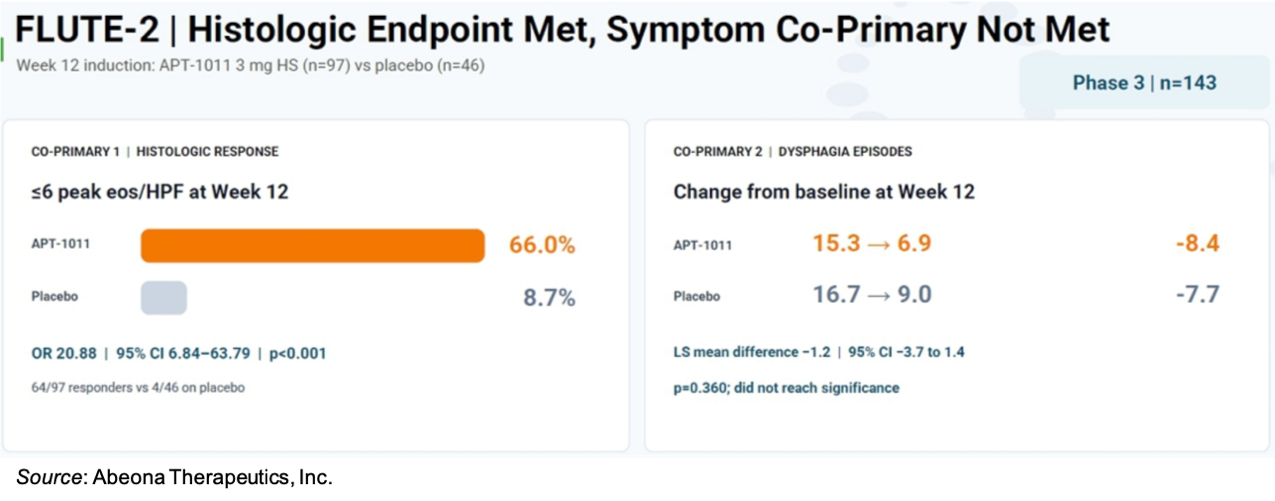
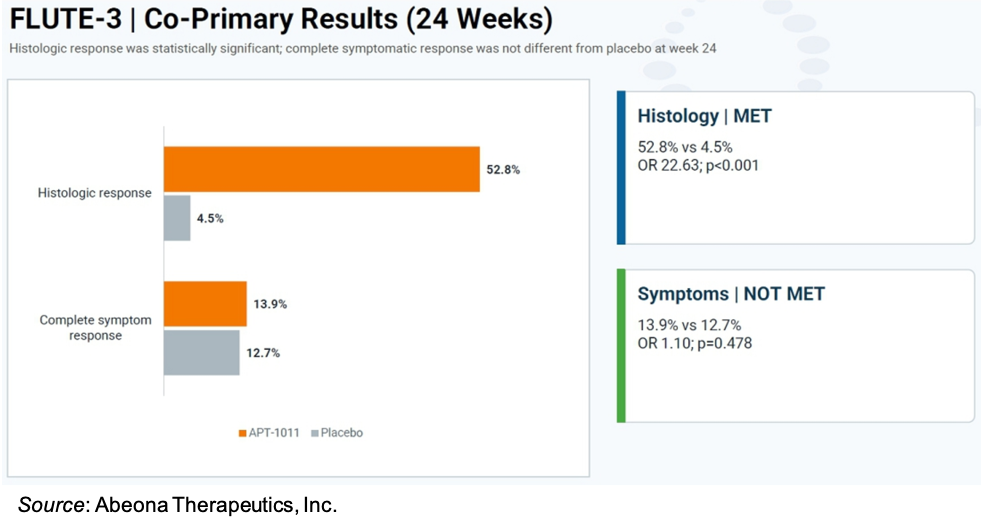
Management believes that the previous Phase 3 studies were affected, in part, by the symptom assessment instrument used. The trials employed a proprietary patient-reported outcome tool known as PROSE, which did not distinguish between solid, soft, and liquid foods and provided limited guidance regarding how patients should quantify swallowing difficulty.
In contrast, the Dysphagia Symptom Questionnaire (DSQ) is a validated patient-reported outcome instrument used in clinical studies of approved EoE therapies (Dellon et al., 2013). It incorporates more structured questions regarding food consumption and the patient’s response to swallowing difficulties.
A post-hoc analysis mapping responses from the previous FLUTE 3 study to the DSQ suggested an approximately 13-percentage-point improvement in responder rate relative to placebo. Management believes this supports the potential for a more successful symptom endpoint using the validated instrument.
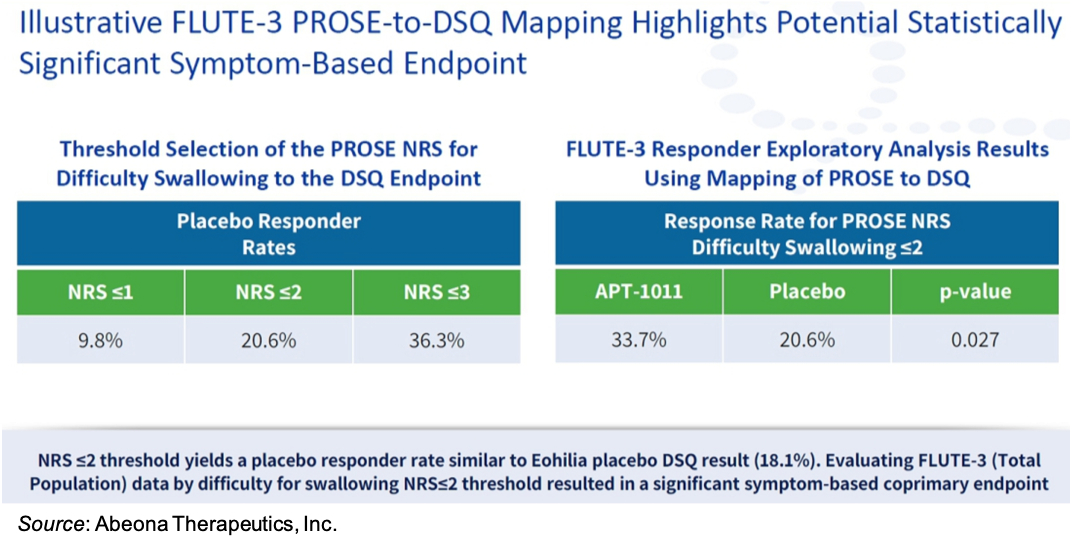
This analysis is encouraging but investors should be aware of its limitations. It is retrospective and does not establish that a future prospective trial will meet its primary endpoint. The DSQ may reduce measurement variability, but clinical efficacy still needs to be demonstrated prospectively.
Phase 3 Study and Development Timeline
Abeona anticipates initiating a new Phase 3 study in mid-2027, subject to FDA feedback on the proposed design. The company currently envisions approximately 400 patients randomized to ABO-801 3 mg once daily at bedtime or placebo. The proposed co-primary endpoints will assess histologic response and symptomatic improvement using the DSQ at Week 12. Secondary endpoints at Week 24 will evaluate durability of activity. The selection of a Week 12 primary assessment is intended to limit variability from changes in patient diets, which can become increasingly relevant during longer clinical trials. Management also indicated that the trial will include a broader representation of moderate and severe disease, where the signal-to-noise ratio for symptomatic improvement may be more favorable.
A Type C meeting with the FDA is planned to discuss the proposed study design. Regulatory feedback will be an important milestone, particularly with respect to endpoint definitions, statistical assumptions, and whether the agency agrees that the proposed trial can support a future NDA submission. Topline results may be available at the end of 2028, depending on study initiation and enrollment. Assuming a successful study, we estimate an NDA submission in 2029 and potential FDA approval in 2030, which we believe are reasonable preliminary modeling assumptions.
Financial Update
On November 9, 2026, Abeona announced financial results for the third quarter of 2026. The company reported net product revenue of $13.5 million, which represented a quarter-over-quarter increase of 18% compared to the $11.4 million in the second quarter of 2026. As discussed above, revenue was recognized for five treatments based on one batch failed to meet the required pan-cytokeratin (pan-CK) identity assay release specification. While not recognized in this quarter, Abeona retains potential royalty income from FAYUVI™, which Ultragenyx received FDA approval for in September 2026. Abeona previously advanced the program before licensing it to Ultragenyx in 2022 and is eligible for commercial milestone payments and tiered royalties of up to 8% on future product sales.
Cost of sales for the third quarter of 2026 were $5.7 million, with gross margins of approximately 58%. Management expect gross margins to ultimately reach approximately 85%-90% once the facility reaches full operating capacity.
R&D expenses in the third quarter of 2026 were $3.7 million compared to $4.2 million for the third quarter of 2025. The reduction was primarily due to a reduction in costs associated with pre-clinical programs that were discontinued. SG&A costs in the third quarter of 2026 were $17.1 million compared to $19.3 million for the third quarter of 2025. The decrease was primarily due to a decrease associated with engineering runs that took place in the prior period.
Abeona exited the third quarter of 2026 with approximately $134.9 million in cash and cash equivalents. Subsequent to the end of the quarter the company entered into a securities purchase agreement for a private placement of 6.4 million shares of common stock at a purchase price of $3.75 per share and pre-funded warrants to purchase up to 1,600,043 shares of common stock at a purchase price of $3.7499 per pre-funded warrant for gross proceeds of $30 million. As of November 5, 2026, the company had approximately 57.1 million shares outstanding and when factoring in the shares issued to Ellodi for ABO-801, the shares and pre-funded warrants issued in the private placement, and the restricted shares, warrants, and stock options previously issued, we arrive at a fully diluted share count of approximately 82.6 million.
Conclusion
Abeona’s third quarter 2026 results and the acquisition of ABO-801 represent a meaningful evolution in the company’s investment thesis. Zevaskyn is establishing a commercial foundation in RDEB, while ABO-801 adds a late-stage development opportunity in a substantially larger therapeutic market.
Zevaskyn’s 18% sequential revenue growth, expansion to eight QTCs, and increasing treatment experience are encouraging, however the annual manufacturing shutdown will constrain biopsy collections during the latter part of the 4Q26 and early part of 1Q27, thus sequential revenue growth will likely be limited through 1Q27. Looking ahead, management’s target of expanding capacity to ten patient slots per month by mid-2027 should provide additional flexibility, while anticipated gross margins of 85%-90% at full manufacturing utilization represent meaningful operating leverage if commercial volumes develop as expected.
The acquisition of ABO-801 provides a potentially valuable second growth drive. Its once-daily oral formulation, low systemic exposure, and established clinical history are attractive characteristics in a chronic disease requiring ongoing management. We preliminarily estimate peak sales of approximately $300 million with a 40% initial probability of success and an estimated approval in 2030 if the next Phase 3 trial succeeds.
The company has multiple upcoming catalysts that investors should be aware of, including interim data from the Phase 2b trial of EP-104GI in EoE in December 2026, an FDA Type C meeting for ABO-801 in the first half of 2027, and 4Q26 results for Zevaskyn. After incorporating the private placement and ABO-801 into our model our valuation is now $13 per share.
SUBSCRIBE TO ZACKS SMALL CAP RESEARCH to receive our articles and reports emailed directly to you. Please visit our website for additional information on Zacks SCR.
DISCLOSURE: Zacks SCR has received compensation from the issuer directly, from an investment manager, or from an investor relations consulting firm, engaged by the issuer, for providing research coverage for a period of no less than one year. Research articles, as seen here, are part of the service Zacks SCR provides and Zacks SCR receives payments totaling a maximum fee of up to $50,000 annually for these services provided to or regarding the issuer. Full Disclaimer HERE.