
PERTH, Australia, July 05, 2026 (GLOBE NEWSWIRE) — Alkane Resources Limited (ASX: ALK; TSX: ALK; OTCQX: ALKRY) (‘Alkane’ or ‘the Company’) is pleased to announce the latest exploration results for extension and infill drilling of the True Blue deposit, located 2 km west of the active underground workings at its Costerfield Operation in central Victoria, Australia.
Program Summary
- An additional 33 holes targeting the Freeman veining within the True Blue deposit have been drilled since Alkane’s previous update (ASX announcement 15 October 2025 titled ‘Costerfield Resource and Reserve Statement).
- The new drilling predominantly targeted infill of the upper portion of the deposit and has significantly increased confidence in understanding the vein geometry and grade-controlling structures.
- The higher resolution granted by the infill drilling indicates there is further veining complexity that serves to break-up a previously interpreted high-grade panel.
- Current and future exploration drilling will target along-strike repetitions of mineralisation at True Blue both to the north and south, and investigate the link between it and the West Costerfield prospect.
True Blue Assay Highlights
- From Freeman (700) Vein:
- 57.6g/t gold and 25.4% antimony over 0.25m (ETW 0.17m) in TB055
- 20.9g/t gold and 19.5% antimony over 0.31m (ETW 0.22m) in TB057
- 4.3g/t gold and 6.4% antimony over 0.8m (ETW 0.63m) in TB080
- 30.1g/t gold and 14.8% antimony over 0.27m (ETW 0.17m) in TB065
- From associated veins
- 84.1g/t gold and 15.4% antimony over 0.48m (ETW 0.36m) in TB084 (702 splay)
- 17.9g/t gold and 1.7% antimony over 3.2m (ETW 1.4m) in TB053 (705 vein)
- 19.3g/t gold and 29.3% antimony over 0.22m (ETW 0.16m) in TB079
- 11.2g/t gold and 5.7% antimony over 0.77m (ETW 0.54m) in TB055
Alkane Managing Director & CEO, Nic Earner, said:
“The infill drilling of True Blue gives us the geological confidence needed to proceed with our plans for development of the deposit. The geological context gained from the drilling has also enhanced the model for further targeting along the True Blue Corridor. True Blue is certainly more complex than our original estimates, we are encouraged by the progress made and excited by the targets yet to be tested.”
Costerfield Gold-Antimony Field
Alkane Resources Ltd 100%
The Costerfield gold-antimony deposit was discovered in 1861, antimony having been already identified in the district as early as 1853 as prospectors attracted to the McIvor (Heathcote) alluvial gold rush began to explore the surrounding hills for the primary deposits. Several lodes along a 3km corridor were rapidly opened up with the bulk of historical production coming from leases at the northern end of the field; the Costerfield (Main), Bombay and Minerva mines. Production from these mines primarily took place in two phases, between 1861-1883 and 1903-1924, and a short-lived attempt at redeveloping the mine occurred between 1933-1939.
Modern mining has been continuous since 2006, when Australian Gold Development commenced underground operations at Augusta, at the southern end of the field. AGD’s Costerfield operation was purchased by Mandalay Resources in 2010, and extraction of the vertically continuous vein system has progressively moved north beneath the Costerfield, Minerva and Bombay group of mines, where Mandalay’s high-grade Youle and Shepherd lodes were discovered.
The True Blue deposit is first recorded in an 1864 government survey map of the Costerfield area, and was initially worked down to the water table for a short time after discovery. It has been subject to minor prospecting activity since, and in 2010 Mandalay Resources drilled the first diamond drillhole below the surface workings. However, it was not until 2022 with drillhole TB010 that economic grades were encountered and testing of the Freeman veining became a major focus of exploration at Costerfield.
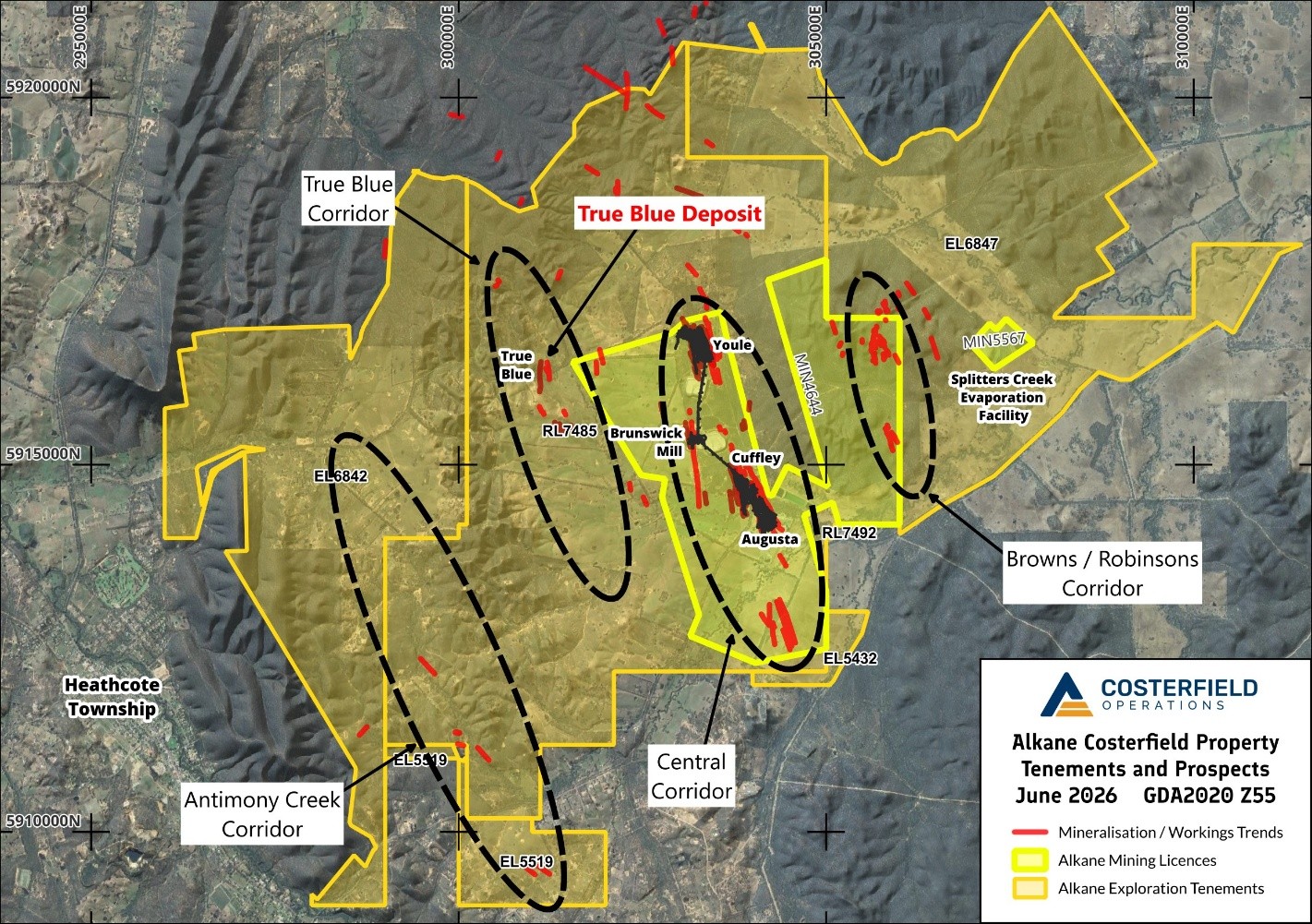
Figure 1. Regional map of the Costerfield Project in GDA2020 grid showing Alkane tenements and the main corridors of mineralisation identified, highlighting the location of the True Blue deposit.
Deposit Geology
True Blue is located on the western flank of the Costerfield Dome, hosted by Silurian marine siltstones of the Costerfield Formation which correlate via marker beds to the same stratigraphic level as the Youle, Brunswick and Augusta deposits. The siltstone is extensively thickened by duplex ramping into a doubly plunging antiformal thrust stack or dome, within which the bulk of observed mineralisation sits. The main mineralised structures are situated within the western limb of the dome, but many other parallel vertical shears with varying degrees of mineralisation are found closer to the hinge and on the eastern limb. The dominant mineralised structure identified at True Blue has been named the Freeman Vein, and is assigned the Costerfield resource code of 700. Other modelled veins within the deposit include the 702 and 705, which lie close by east and west of the Freeman vein respectively (Figure 2), and the 710 and 720 which occur parallel further east.
The cap of the target veins is well defined by the Wombat Fault, which is strongly lithologically controlled and runs along a ~50cm thick isolated sandstone bed that appears to have acted as the main detachment plane for the thrust stack. The fault is observed in the same stratigraphic position over the entire dome. Lower tenor mineralisation, including the surficial True Blue prospect, occurs above the fault somewhat offset to the east from the Freeman veining.
The footwall boundary of the target system is also well understood. The large, west-dipping Komodo thrust fault truncates the Freeman veining and the host dome. It is also observed that the fault follows the same distinctive sandstone marker bed in its footwall. The apparent along-plane displacement along the Wombat-Komodo sandstone detachment is thus significant, approaching at least 1,000m if restored to its original planar and horizontal position. Mineralisation of moderate tenor has been observed in drilling below the Komodo Fault in an offset position and remains a target for further testing.
Mineralisation at the north and south boundaries of the current resource is of lower grade, which appears to correlate with the increasing plunge of the host dome stratigraphy and bedded structures at the extremities. This observation is in line with other mined Costerfield deposits and reinforces Alkane’s plan to locate and target further dome repetitions along strike in the future.
The current round of infill drilling has resolved the Freeman vein into a sheeted series of vertical north-south veins, generally single-generation fracture fill quartz-stibnite similar in nature to the Kendal deposit at Costerfield as opposed to shear-hosted mineralisation such as found at Brunswick/Cuffley. Mineralised linking structures cross between primary veins at oblique angles. Bedding parallel and subparallel laminated quartz veins and faults also intersect the veins, creating local grade boundaries and complex splay vein arrays. These factors combine to introduce localised complexity (and upside potential) into the system which is otherwise remarkably planar at the deposit scale.
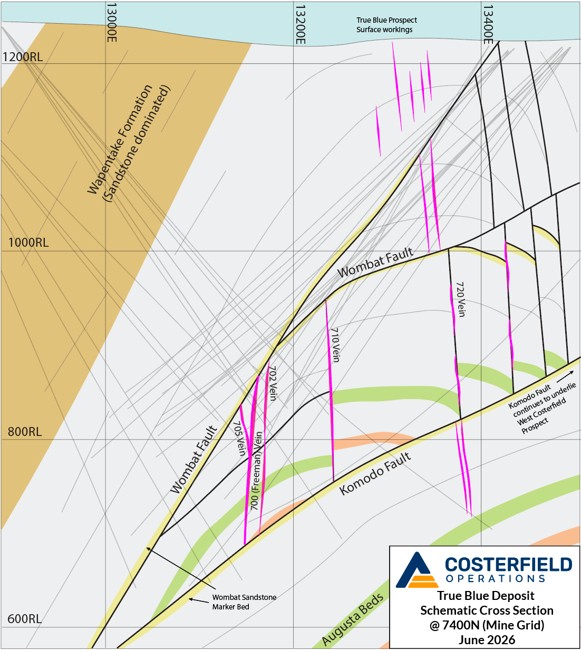
Figure 2. Geological cross section of the True Blue gold-antimony vein system at mine northing 7400N, showing the Freeman vein and associated mineralisation positions relative to the True Blue antiformal dome, and its relationship with known bounding and crosscutting faults. n.b. All traces of new drillholes intersecting the Freeman Vein are illustrated, some appear to not intersect due to the off section effect of the lode system striking ~30 degrees east of mine grid north (see plan section).
Drilling Results
Since the previous release (refer to the Costerfield Resources and Reserves Statement FY25 released on the ASX and TSX on 15 October 2025), 33 growth and infill holes have been completed, totalling 19,012m of diamond drill core. The recent drilling has been concentrated on infilling the upper portion of the Freeman vein and refining structural information to build confidence in the geological model. The deposit from approximately 800RL down to the Komodo Fault footwall contact remains relatively sparsely infilled. Several ore-grade intercepts were made on the Freeman vein, the best of which was from drillhole TB055 (Figure 6) which resulted in 57.6g/t gold and 25.4% antimony over 0.25m (ETW 0.17m). The latest hole drilled into the deposit, TB084, intersected a wide zone of veining (Figure 7) that contained high grade gold and antimony, interpreted to represent a linking zone between the 702 and 705 veins. The best interval within this zone graded 84.1g/t gold and 15.4% antimony over 0.48m (ETW 0.36m).
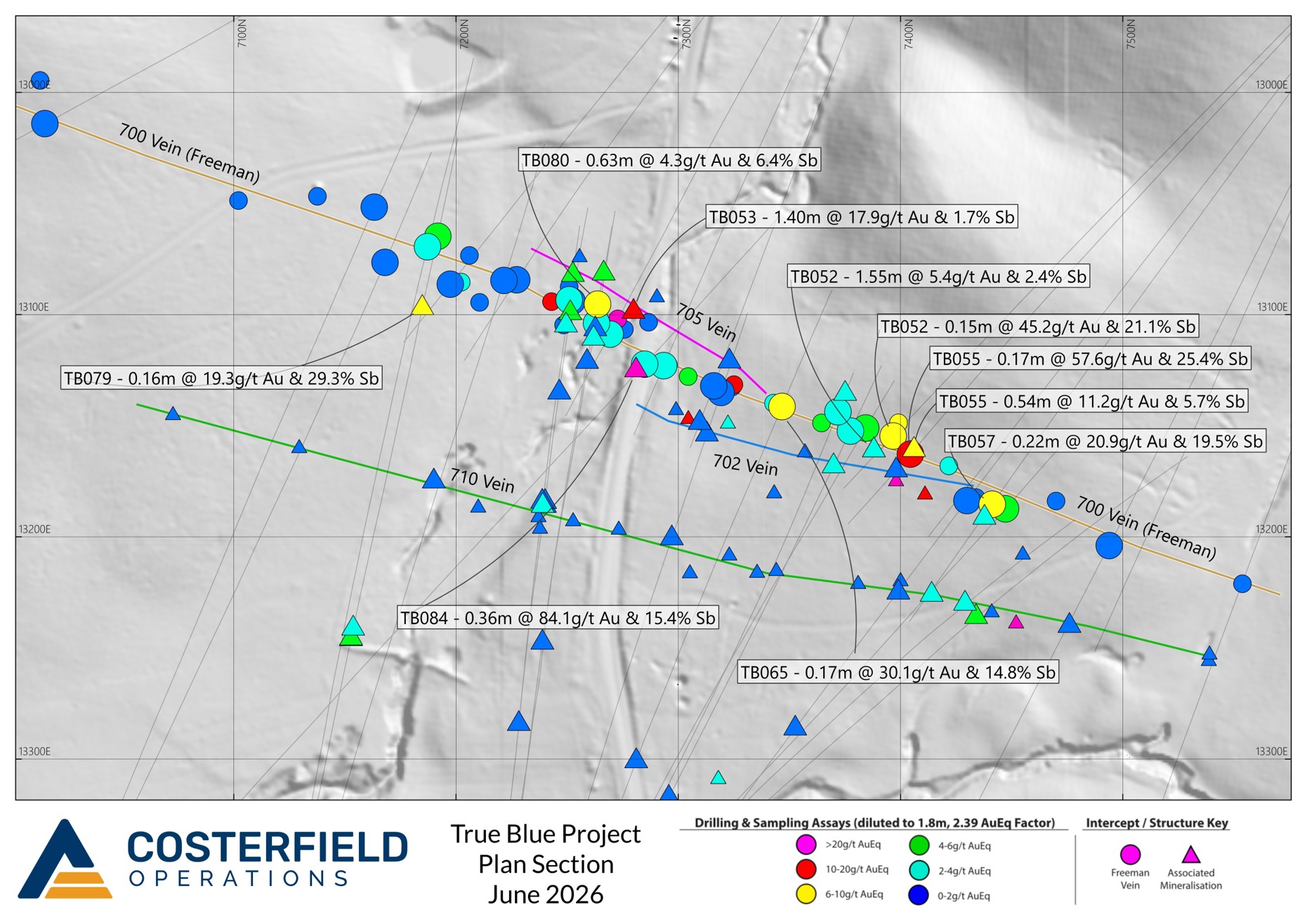
Figure 3. True Blue Deposit Plan Section with major True Blue vein best fit traces displayed, recent drill traces and labels for new intercepts of > 6g/t AuEq when diluted over 1.8m. Older significant drill intercepts are displayed as smaller, unlabelled icons.
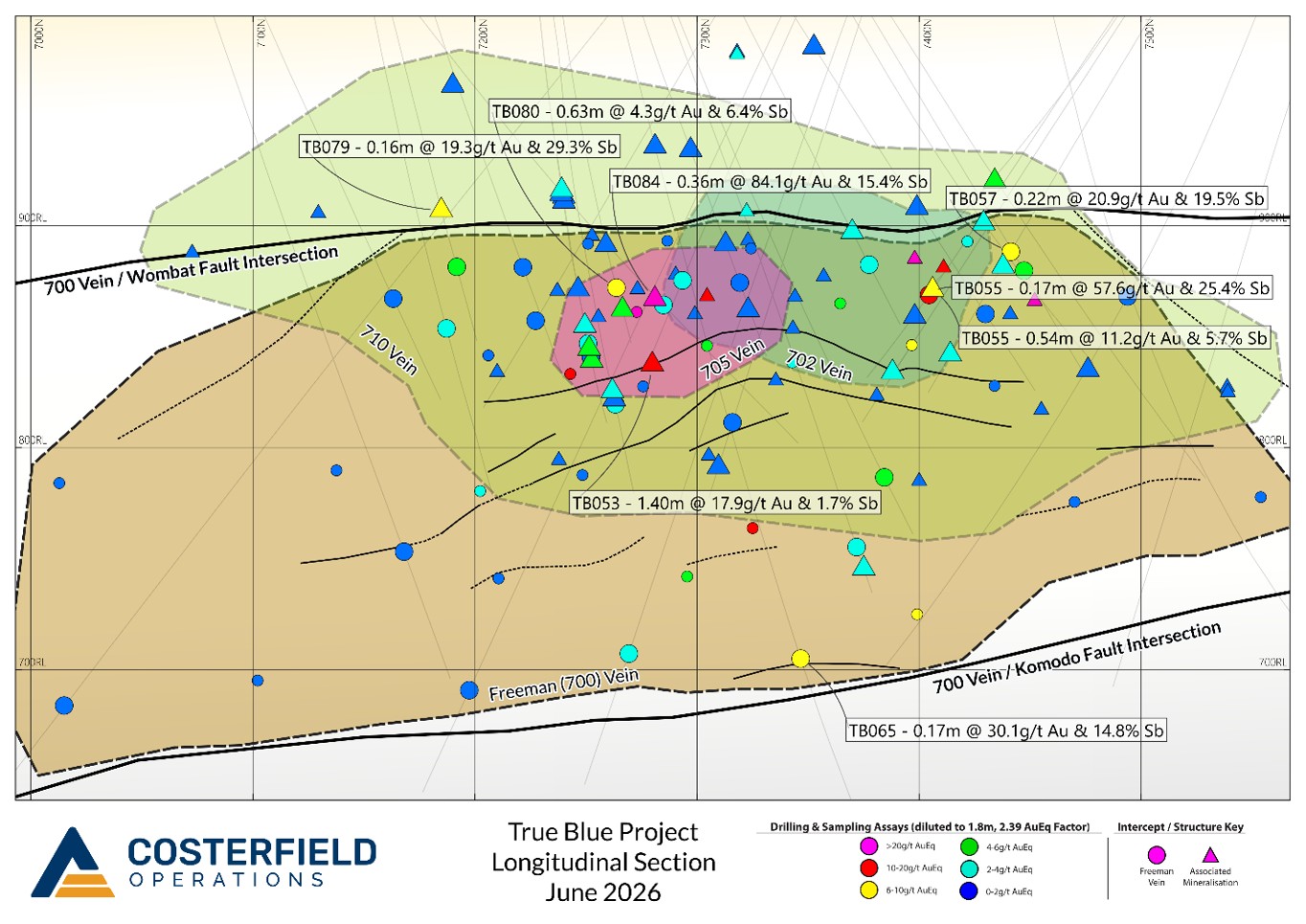
Figure 4. Long Section True Blue deposit with major vein target envelopes displayed, recent drill traces and labels for new intercepts of > 6g/t AuEq when diluted over 1.8m. Older significant drill intercepts are displayed as smaller, unlabelled icons.
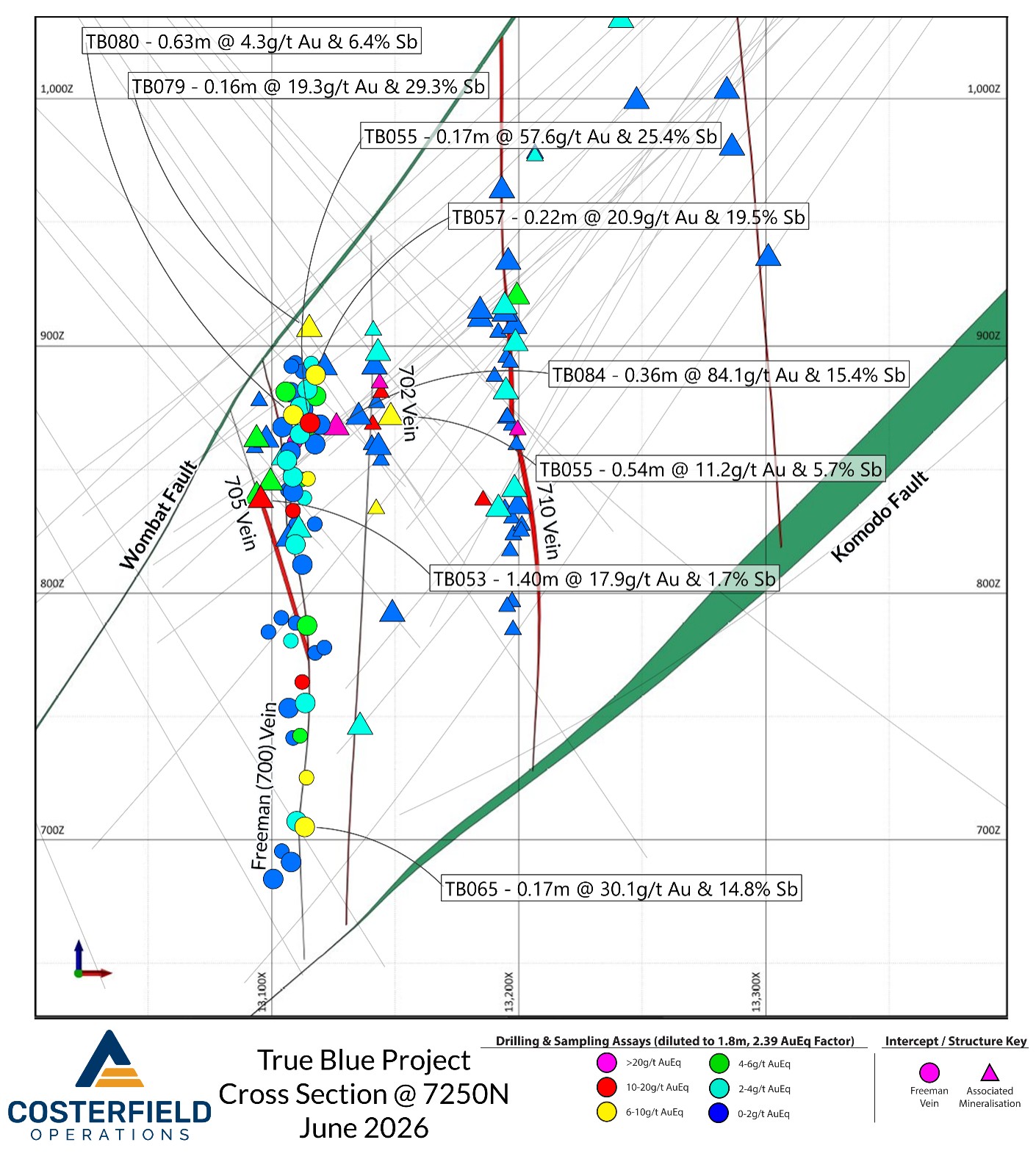
Figure 5. Schematic Cross section looking north at mine northing 7250N showing True Blue veins and > 6g/t AuEq new intercepts labelled. Older significant drill intercepts are displayed as smaller, unlabelled icons. Intercept eastings have been adjusted to cluster around their assigned veins at this northing to combat off-section effect over the length of the deposit.
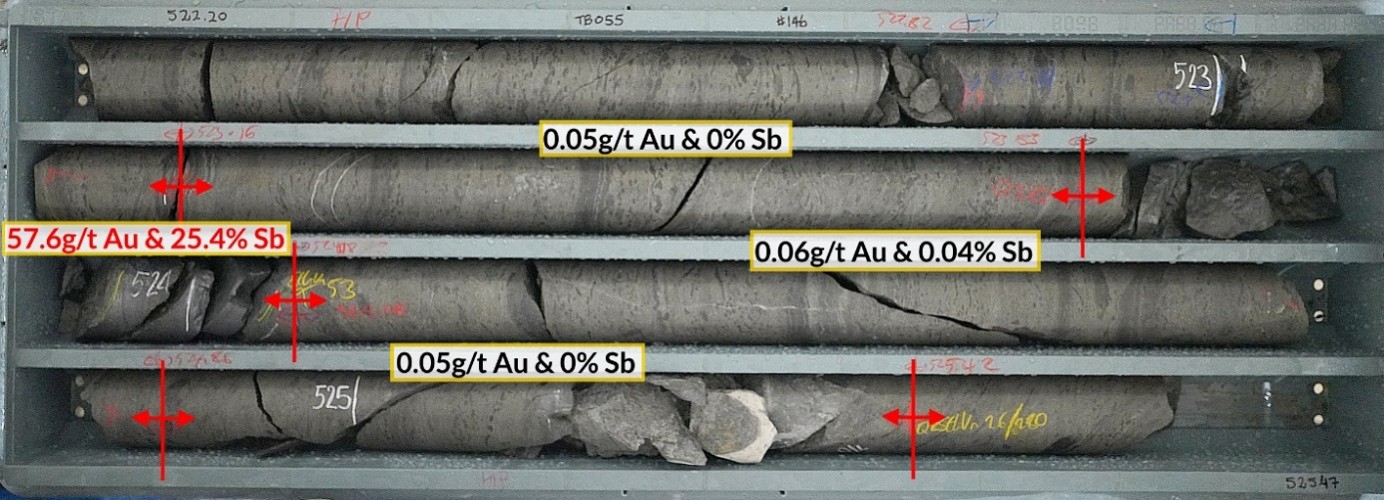
Figure 6. Core tray photo of the Freeman vein intercept described in this announcement, 57.6g/t gold and 25.4% antimony over 0.25m (ETW 0.20m) in drillhole TB055. The intercept is stibnite-rich with only minor quartz while still carrying significant gold, a common characteristic of the Freeman vein.
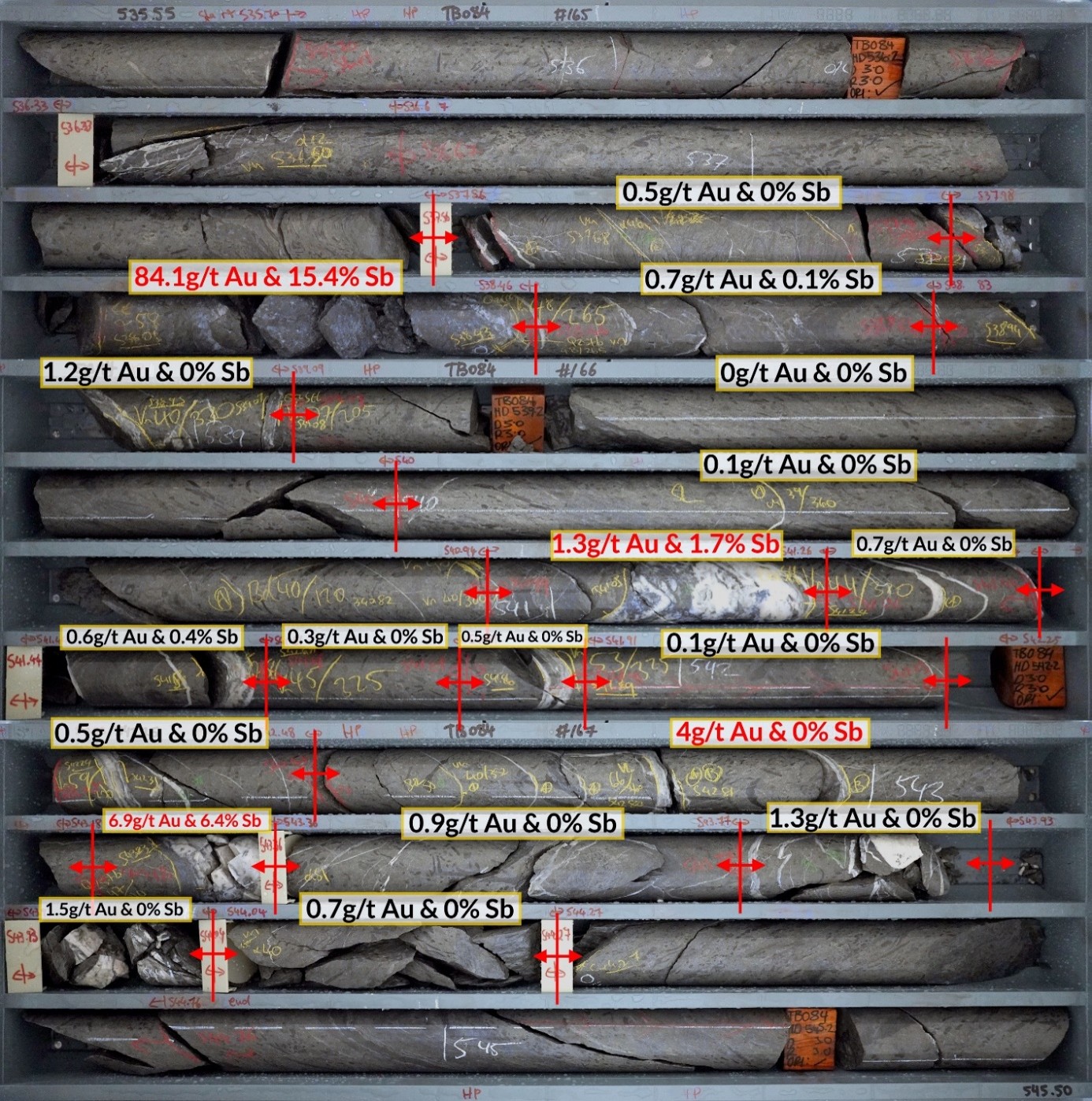
Figure 7. Core tray photograph of the Freeman-702 vein splay zone intersected in TB084, where the highest grade interval of the drill program was intersected.
Future Plans
Going into FY26-27, continued drilling at True Blue will focus on testing along strike to identify additional deposits. Nearby prospectivity is apparent in several directions from the current resource:
- North – Soil sampling indicates the True Blue geochemical anomaly may persist at least several hundred metres further north than the current edge of the Freeman resource. At surface approximately 200m north of the resource, outcrops a shear that hosts an albitised and silicified felsic dyke that is strongly anomalous in antimony with pXRF analysis, further evidence indicating persistence of the mineralised system northward from the tested area.
- South – Diamond drillhole TB022 in early 2024 intersected a wide zone of gold-antimony mineralisation approximately 550m south of the current resource boundary. This zone included 2.6g/t gold over 2.38m (2.00m ETW) (Refer to 28 January 2025 TSX Announcement – Mandalay Intercepts 578 g/t Gold and 20% Antimony over 0.47 Metres at True Blue) Geological interpretation of the drill data suggests that this area may host a repetition of the domal structure that appears to have been important for developing economic mineralisat Freeman and is a high priority for further testing.
- Depth – The footwall of the Freeman vein system is defined by the regional-scale Komodo thrust fault. Tails of several diamond drillholes at True Blue have encountered vertical mineralised veins below this fault, including veins drilled in hole TB037 discussed in the previous release (Refer to TSX Announcement – 21 July 2025 – Mandalay Extends High-Grade True Blue Discovery. The veins in the Sub-Komodo domain have not been explicitly targeted to date and has high potential for hosting a large mineralised system.
- East – The West Costerfield prospect sits approximately 800m east of the True Blue deposit and shares a potential ore fluid pathway – the Komodo Fault. At West Costerfield, the fault is much closer to surface, and exhibits localised intense hydrothermal brecciation. The structural environment below the Komodo Fault has not been drill tested away from True Blue, and as the depth prospectivity at True Blue demonstrates is likely to host mineralised veins that are offset from the surface deposit at West Costerfield.
The exploration targets described herein are conceptual in nature. There has been insufficient exploration to define a mineral resource in these areas and it is uncertain if further exploration will result in the delineation of a mineral resource.
An updated True Blue resource will be announced as part of Alkane’s upcoming Resource and Reserves Statement.
This document has been authorised for release to the market by Nic Earner, Managing Director and CEO.
ABOUT ALKANE ‐ www.alkres.com ‐ ASX:ALK | TSX: ALK | OTCQX: ALKRY
Alkane (ASX:ALK; TSX:ALK; OTCQX:ALKRY) is an Australia-based gold and antimony producer with a portfolio of three operating mines across Australia and Sweden. The Company has a strong balance sheet and is positioned for further growth.
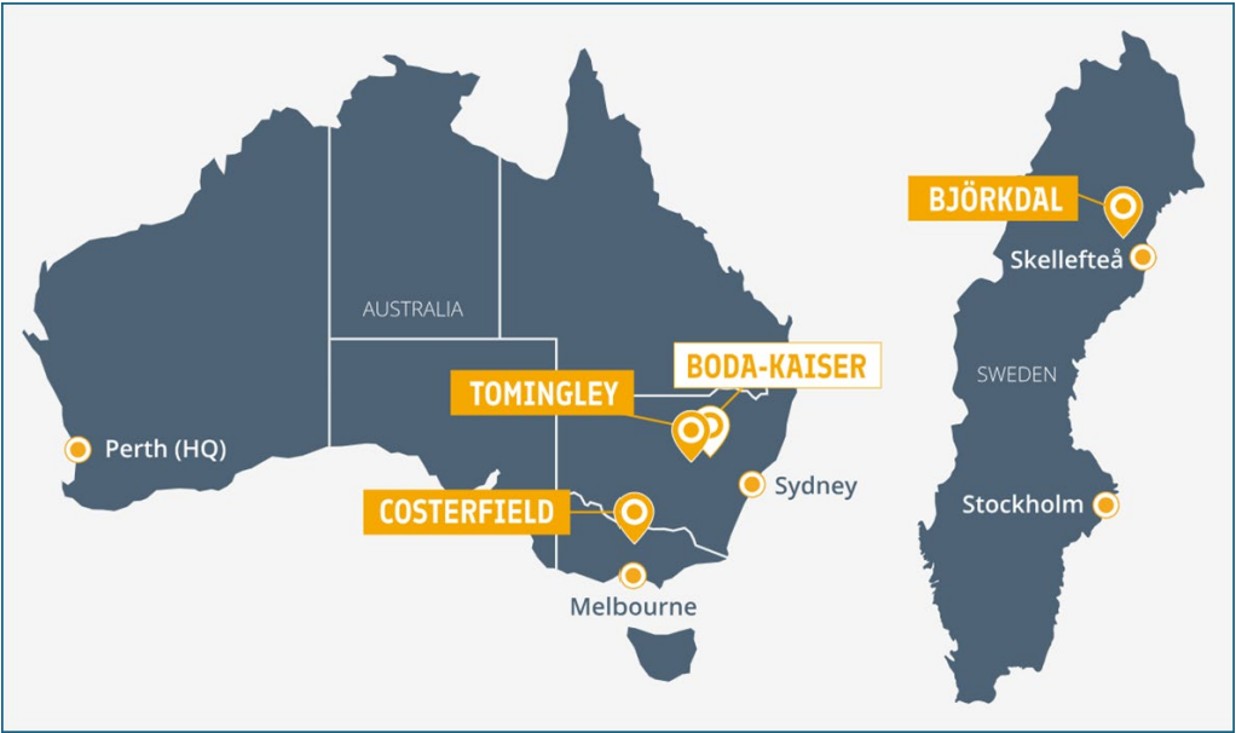
Alkane’s wholly owned producing assets are the Tomingley open pit and underground gold mine southwest of Dubbo in Central West New South Wales, the Costerfield gold and antimony underground mining operation northeast of Heathcote in Central Victoria, and the Björkdal underground gold mine northwest of Skellefteå in Sweden (approximately 750 km north of Stockholm). Ongoing near-mine regional exploration continues to grow resources at all three operations.
Alkane also owns the very large gold-copper porphyry Boda-Kaiser Project in Central West New South Wales and has outlined an economic development pathway in a Scoping Study. The Company has ongoing exploration within the surrounding Northern Molong Porphyry Project and is confident of further enhancing eastern Australia’s reputation as a significant gold, copper and antimony production region.
Competent / Qualified Persons Statement
Certain information in this announcement relating to Exploration Results has been previously released to the ASX. Alkane confirms that it is not aware of any new information or data that materially affects the information included in those market announcements and that all material assumptions and technical parameters underpinning the estimates and Exploration Results in those announcements continue to apply and have not materially changed.
The information in this report that relates to the Costerfield Exploration Results is based on, and fairly represents, information compiled and verified by Mr Chris Davis. Mr Davis is a Chartered Professional (Geology) of the Australasian Institute of Mining and Metallurgy (MAusIMM CP(Geo)) and a Member of the Australian Institute of Geoscientists (MAIG).
Mr Davis has sufficient experience that is relevant to the style of mineralisation and type of deposit under consideration and to the activity being undertaken to qualify as a Competent Person as defined in the 2012 Edition of the “Australian Code for Reporting of Exploration Results, Mineral Resources, and Ore Reserves” (JORC Code).
For the purposes of National Instrument 43-101 – Standards of Disclosure for Mineral Projects (‘NI 43-101’), the scientific and technical information contained in this announcement relating to the Costerfield Exploration Results has been prepared under the supervision of, and approved by, Mr Chris Davis, who is a “qualified person” as defined in NI 43-101. Mr Davis is employed by Alkane as Chief Geologist and, as an employee of Alkane, is not considered independent of Alkane within the meaning of NI 43-101.
Mr Davis consents to the inclusion in this report of the matters based on his information in the form and context in which they appear.
Cautionary Note Regarding Forward-Looking Information and Statements
This announcement contains certain forward-looking information and forward-looking statements within the meaning of applicable securities legislation and may include future-oriented financial information or financial outlook information (collectively Forward-Looking Information). Actual results and outcomes may vary materially from the amounts set out in any Forward-Looking Information. As well, Forward-Looking Information may relate to: future outlook and anticipated events; expectations regarding exploration potential; production capabilities and future financial or operating performance, including AISC, investment returns, margins and share price performance; production and cost guidance and the timing thereof; issuing updated resources and reserves estimate and the timing thereof; the potential of Alkane to meet industry targets, public profile and expectations; and future plans, projections, objectives, estimates and forecasts and the timing related thereto.
Forward-Looking Information is generally identified by the use of words like “will”, “create”, “enhance”, “improve”, “potential”, “expect”, “upside”, “growth” and similar expressions and phrases or statements that certain actions, events or results “may”, “could”, or “should”, or the negative connotation of such terms, are intended to identify Forward-Looking Information.
Although Alkane believes that the expectations reflected in the Forward-Looking Information are reasonable, undue reliance should not be placed on Forward-Looking Information since no assurance can be provided that such expectations will prove to be correct. Forward-Looking Information is based on information available at the time those statements are made and/or good faith belief of the officers and directors of Alkane as of that time with respect to future events and are subject to risks and uncertainties that could cause actual results to differ materially from those expressed in or suggested by the Forward-Looking Information. Forward-Looking Information involves numerous risks and uncertainties. Such factors include, without limitation: risks relating to changes in the gold and antimony price.
Forward-Looking Information is designed to help readers understand Alkane’s views as of that time with respect to future events and speak only as of the date they are made. Except as required by applicable law, Alkane assumes no obligation to update or to publicly announce the results of any change to any forward-looking statement contained or incorporated by reference herein to reflect actual results, future events or developments, changes in assumptions or changes in other factors affecting the Forward-looking Information. If Alkane updates any one or more forward-looking statements, no inference should be drawn that the company will make additional updates with respect to those or other Forward-looking Information. All Forward-Looking Information contained in this announcement is expressly qualified in its entirety by this cautionary statement.
Disclaimer
Alkane has prepared this announcement based on information available to it. No representation or warranty, express or implied, is made as to the fairness, accuracy, completeness or correctness of the information, opinions or conclusions contained in this announcement. To the maximum extent permitted by law, none of Alkane, its directors, officers, employees, associates, advisers and agents, nor any other person accepts any liability, including, without limitation, any liability arising from fault or negligence on the part of any of them or any other person, for any loss arising from the use of this announcement or its contents or otherwise arising in connection with it.
This announcement is not an offer, invitation, solicitation, or other recommendation with respect to the subscription for, purchase or sale of any security, and neither this announcement nor anything in it shall form the basis of any contract or commitment whatsoever.
APPENDIX 1 – Tabulated Drilling Results
Significant intercepts from the True Blue infill drilling program at Costerfield
| Drill Hole ID | From (m) | To (m) | Interval (m) | Estimated True Width (m) |
Au (g/t) | Sb (%) | Gold-equiv. grade diluted to 1.8 m (g/t) |
Interpreted Vein |
| TB051 | 528.32 | 528.44 | 0.12 | 0.09 | 0.1 | 0.6 | 0.1 | 700 |
| TB052 | 539.77 | 540.01 | 0.24 | 0.15 | 45.2 | 21.1 | 8.2 | 700 |
| TB054 | 510.28 | 510.43 | 0.15 | 0.11 | 1.0 | 0.1 | 0.1 | 700 |
| TB055 | 523.83 | 524.08 | 0.25 | 0.17 | 57.6 | 25.4 | 11.5 | 700 |
| TB056 | 509.30 | 509.84 | 0.54 | 0.40 | 2.3 | 3.5 | 2.4 | 700 |
| TB057 | 505.95 | 506.26 | 0.31 | 0.22 | 20.9 | 19.5 | 8.2 | 700 |
| TB058 | 514.95 | 515.44 | 0.49 | 0.33 | 13.9 | 0.7 | 2.9 | 700 |
| TB060 | 524.90 | 525.11 | 0.21 | 0.16 | 0.8 | 0.0 | 0.1 | 700 |
| TB061 | 560.35 | 561.25 | 0.90 | 0.62 | 2.4 | 1.4 | 1.9 | 700 |
| TB063 | 510.26 | 514.75 | 4.49 | 3.48 | 0.0 | 0.0 | 0.0 | 700 |
| TB064 | 641.36 | 641.65 | 0.29 | 0.17 | 19.6 | 1.3 | 2.2 | 700 |
| TB065 | 638.94 | 639.21 | 0.27 | 0.17 | 30.1 | 14.8 | 6.0 | 700 |
| TB066 | 667.79 | 667.97 | 0.18 | 0.10 | 5.7 | 1.5 | 0.5 | 700 |
| TB067 | 603.21 | 606.00 | 2.79 | 1.77 | 1.5 | 0.3 | 2.3 | 700 |
| TB069 | 736.86 | 737.00 | 0.14 | 0.01 | 0.1 | 6.3 | 0.4 | 700 |
| TB072 | 454.86 | 455.21 | 0.35 | 0.20 | 37.3 | 3.5 | 5.2 | 700 |
| TB073 | 555.45 | 555.55 | 0.10 | 0.07 | 32.4 | 21.2 | 3.4 | 700 |
| TB075 | 547.21 | 547.38 | 0.17 | 0.13 | 2.3 | 8.6 | 1.7 | 700 |
| TB075W2 | 543.70 | 543.85 | 0.15 | 0.12 | 7.7 | 15.4 | 2.9 | 700 |
| TB076 | 520.19 | 520.54 | 0.35 | 0.25 | 5.7 | 4.3 | 2.2 | 700 |
| TB077 | 496.86 | 496.99 | 0.13 | 0.10 | 1.5 | 7.4 | 1.0 | 700 |
| TB079 | 505.54 | 505.78 | 0.24 | 0.18 | 12.4 | 12.6 | 4.4 | 700 |
| TB080 | 524.88 | 525.68 | 0.80 | 0.63 | 4.3 | 6.4 | 6.9 | 700 |
| TB082 | 535.93 | 536.24 | 0.31 | 0.23 | 1.5 | 0.0 | 0.2 | 700 |
| TB083 | 602.16 | 602.35 | 0.19 | 0.12 | 0.0 | 0.0 | 0.0 | 700 |
| TB084 | 542.48 | 543.36 | 0.88 | 0.64 | 4.6 | 1.3 | 2.8 | 700 |
| TB085 | 572.67 | 573.15 | 0.48 | 0.31 | 4.0 | 9.1 | 4.5 | 700 |
| TB052 | 548.80 | 550.44 | 1.64 | 1.55 | 5.4 | 2.4 | 9.6 | 702 |
| TB054 | 483.94 | 484.04 | 0.10 | 0.08 | 2.0 | 2.7 | 0.4 | 702 |
| TB055 | 536.81 | 537.61 | 0.80 | 0.51 | 0.5 | 1.0 | 0.8 | 702 |
| TB056 | 486.49 | 486.86 | 0.37 | 0.26 | 7.4 | 4.6 | 2.7 | 702 |
| TB053 | 529.80 | 533.00 | 3.20 | 1.40 | 17.9 | 1.7 | 17.0 | 705 |
| TB054 | 528.84 | 529.18 | 0.34 | 0.27 | 1.0 | 0.3 | 0.3 | 705 |
| TB075W2 | 557.32 | 557.79 | 0.47 | 0.41 | 5.8 | 5.2 | 4.2 | 705 |
| TB080 | 542.38 | 542.62 | 0.24 | 0.21 | 11.4 | 9.7 | 4.1 | 705 |
| TB054 | 418.66 | 419.19 | 0.53 | 0.48 | 3.5 | 0.6 | 1.3 | 710 |
| TB057 | 574.00 | 575.33 | 1.33 | 1.03 | 3.0 | 0.9 | 2.9 | 710 |
| TB060 | 452.40 | 452.80 | 0.40 | 0.28 | 0.5 | 0.0 | 0.1 | 710 |
| TB063 | 564.19 | 566.30 | 2.11 | 1.36 | 1.2 | 0.5 | 1.8 | 710 |
| TB071 | 410.85 | 414.12 | 3.27 | 1.78 | 1.1 | 1.0 | 3.5 | 710 |
| TB075 | 428.96 | 429.14 | 0.18 | 0.16 | 15.9 | 0.3 | 1.4 | 710 |
| TB075W2 | 427.92 | 428.10 | 0.18 | 0.13 | 25.1 | 6.8 | 2.9 | 710 |
| TB077 | 375.16 | 375.98 | 0.82 | 0.63 | 2.5 | 0.0 | 0.9 | 710 |
| TB078 | 392.94 | 395.22 | 2.28 | 1.47 | 2.6 | 1.8 | 5.6 | 710 |
| TB054 | 179.01 | 180.33 | 1.32 | 0.93 | 2.0 | 0.0 | 1.0 | Other |
| TB055 | 520.11 | 520.88 | 0.77 | 0.54 | 11.2 | 5.7 | 7.5 | Other |
| TB056 | 264.14 | 265.6 | 1.46 | 1.03 | 2.1 | 0.0 | 1.2 | Other |
| TB057 | 516.72 | 517.09 | 0.37 | 0.24 | 6.6 | 8.9 | 3.8 | Other |
| TB060 | 348.83 | 349.75 | 0.92 | 0.65 | 5.2 | 0.0 | 1.9 | Other |
| TB061 | 587.37 | 587.58 | 0.21 | 0.15 | 0.6 | 8.4 | 1.7 | Other |
| TB064 | 634.36 | 635.72 | 1.36 | 1.04 | 2.0 | 0.7 | 2.1 | Other |
| TB065 | 351.57 | 351.97 | 0.40 | 0.28 | 1.3 | 3.3 | 1.4 | Other |
| TB067 | 617.65 | 617.8 | 0.15 | 0.11 | 23.3 | 18.0 | 3.9 | Other |
| TB073 | 545.87 | 546.07 | 0.20 | 0.14 | 14.2 | 14.4 | 3.8 | Other |
| TB073 | 551.69 | 551.91 | 0.22 | 0.16 | 12.7 | 2.5 | 1.6 | Other |
| TB075 | 294.84 | 295.28 | 0.44 | 0.31 | 2.2 | 1.5 | 1.0 | Other |
| TB075 | 432.32 | 432.5 | 0.18 | 0.13 | 5.9 | 7.4 | 1.7 | Other |
| TB075 | 495.74 | 495.84 | 0.10 | 0.07 | 19.0 | 3.8 | 1.1 | Other |
| TB075 | 539.47 | 540.93 | 1.46 | 1.03 | 1.9 | 2.3 | 4.2 | Other |
| TB075W2 | 429.76 | 430.25 | 0.49 | 0.35 | 3.3 | 1.0 | 1.1 | Other |
| TB075W2 | 529.7 | 529.8 | 0.10 | 0.07 | 21.8 | 12.4 | 2.0 | Other |
| TB079 | 263.37 | 263.62 | 0.25 | 0.18 | 4.0 | 3.5 | 1.2 | Other |
| TB079 | 263.84 | 264.0 | 0.16 | 0.11 | 8.9 | 25.3 | 4.4 | Other |
| TB079 | 267.33 | 271.96 | 4.63 | 3.27 | 2.8 | 0.0 | 2.8 | Other |
| TB079 | 464.58 | 464.8 | 0.22 | 0.16 | 19.3 | 29.3 | 7.7 | Other |
| TB080 | 323.8 | 325.02 | 1.22 | 0.86 | 1.0 | 0.8 | 1.4 | Other |
| TB080 | 492.1 | 492.86 | 0.76 | 0.54 | 4.3 | 0.5 | 1.6 | Other |
| TB084 | 537.98 | 538.46 | 0.48 | 0.36 | 84.1 | 15.4 | 24.0 | Other |
| Notes | ||||
| 1. | The AuEq (gold equivalent) grade is calculated using the following formula: | |||
| AuEq g per t = Au g per t + Sb% × | Sb price per 10kg × Sb processing recovery | |||
| Au price per g × Au processing recovery | ||||
| Prices and recoveries used: Au $/oz = 2,500 (Au US$/gram = 80.39); Sb $/t = 19,000 (Sb US$/10kg = 190); Au Recovery = 91% and; Sb Recovery = 92%. The Au recovery assumption and Sb recovery assumption is based on established processing and sales in respect of Costerfield. It is the Company’s opinion that all elements included in the metal equivalent calculation have a reasonable potential to be recovered and sold. | ||||
| 2. | The estimated true width of composites that are not interpreted to be connected to a major vein (identified as “Other” in the above table) have been calculated using a generic, conservative intercept angle (alpha angle) of 45 degrees. | |||
| 3. | Composites that are not interpreted to be connected to a major vein and are below 1 g/t AuEq when diluted to 1.8m are not considered significant and are not recorded here. | |||
Drill hole collar details from True Blue drilling at Costerfield:
| Hole ID | Northing | Easting | Elevation | Depth | Azimuth | Dip | Date Completed |
| TB051 | 7450 | 12782 | 1229 | 586.58 | 126.2 | -44.5 | 21/07/2025 |
| TB052W1 | 7655 | 12889 | 1239 | 552.90 | 134.6 | -46.1 | 20/06/2025 |
| TB054 | 7205 | 13495 | 1217 | 560.36 | 287.4 | -42.3 | 7/07/2025 |
| TB055 | 7655 | 12889 | 1239 | 580.08 | 133.3 | -44.6 | 9/07/2025 |
| TB055W1 | 7655 | 12889 | 1239 | 530.09 | 133.3 | -44.6 | 11/07/2025 |
| TB056 | 7205 | 13496 | 1217 | 551.68 | 296.7 | -40.5 | 30/07/2025 |
| TB057 | 7655 | 12889 | 1239 | 596.47 | 123.0 | -42.9 | 31/07/2025 |
| TB058 | 7450 | 12783 | 1229 | 561.92 | 115.4 | -43.7 | 5/08/2025 |
| TB059 | 7655 | 12889 | 1239 | 521.02 | 127.7 | -41.7 | 21/08/2025 |
| TB060 | 7205 | 13496 | 1217 | 575.30 | 305.2 | -42.8 | 25/08/2025 |
| TB061 | 7451 | 12783 | 1229 | 605.60 | 110.5 | -48.7 | 28/08/2025 |
| TB062 | 7409 | 13727 | 1227 | 799.06 | 281.7 | -44.7 | 13/11/2025 |
| TB063 | 7655 | 12889 | 1239 | 800.29 | 117.4 | -46.6 | 23/09/2025 |
| TB064 | 7451 | 12782 | 1229 | 713.70 | 118.4 | -54.5 | 19/09/2025 |
| TB065 | 7204 | 13496 | 1217 | 724.25 | 297.5 | -53.0 | 22/09/2025 |
| TB066 | 7450 | 12782 | 1229 | 724.52 | 130.5 | -54.3 | 15/10/2025 |
| TB067 | 7205 | 13496 | 1217 | 632.27 | 296.2 | -49.2 | 10/10/2025 |
| TB068 | 7655 | 12889 | 1239 | 676.90 | 117.6 | -53.8 | 8/11/2025 |
| TB069 | 7451 | 12780 | 1232 | 796.40 | 152.0 | -47.6 | 20/11/2025 |
| TB071 | 7240 | 13409 | 1219 | 499.30 | 304.7 | -50.0 | 6/02/2026 |
| TB072 | 7240 | 13409 | 1219 | 515.34 | 315.8 | -47.0 | 15/01/2026 |
| TB073 | 7209 | 13487 | 1217 | 620.15 | 277.5 | -45.7 | 10/12/2025 |
| TB075 | 7209 | 13487 | 1217 | 599.18 | 275.1 | -46.7 | 20/01/2026 |
| TB075W2 | 7209 | 13487 | 1217 | 584.10 | 275.1 | -46.7 | 13/02/2026 |
| TB076 | 7115 | 13436 | 1216 | 635.46 | 279.7 | -44.4 | 23/01/2026 |
| TB077 | 7115 | 13436 | 1216 | 578.10 | 286.8 | -43.3 | 19/02/2026 |
| TB078 | 7239 | 13409 | 1219 | 575.40 | 317.3 | -47.9 | 4/03/2026 |
| TB079 | 7114 | 13436 | 1216 | 561.40 | 281.7 | -42.2 | 6/03/2026 |
| TB080 | 7209 | 13487 | 1217 | 568.50 | 276.7 | -41.2 | 6/03/2026 |
| TB082 | 7005 | 13429 | 1213 | 604.00 | 291.6 | -39.2 | 1/04/2026 |
| TB083 | 7005 | 13430 | 1213 | 680.53 | 295.0 | -49.0 | 24/04/2026 |
| TB084 | 7006 | 13429 | 1214 | 652.60 | 311.6 | -39.6 | 27/05/2026 |
| TB085 | 7210 | 13488 | 1216 | 608.39 | 294.4 | -48.1 | 29/04/2026 |
Notes:
- Coordinate System: Costerfield Local Mine Grid
Appendix 2 – JORC Code, 2012 Edition – Table 1
Section 1 Sampling Techniques and Data
| Criteria | JORC Code explanation | Commentary |
| Sampling techniques |
|
Sampling of Au and Sb mineralisation is from diamond drill core (HQ2, NQ2 and LTK48) and underground channel sampling (face samples).
Due to the discrete mineralisation of the deposit, not all diamond drill core was required to be sampled. Sample intervals were determined and marked on the core by Alkane geologists using the following general rules:
Diamond core sampling intervals were standardised wherever possible and ranged from 5 cm to 1 m in length. Diamond drill core samples have been cut in half using the orientation line or cut line, with a consistent side of the cut core selected for assay to ensure unbiased sampling. Whole core was sampled for LTK48 and Shepherd gold-rich zones. The methodology was validated by the Costerfield QA/QC protocols. No sampling instruments required calibration. Channel samples were collected perpendicular to the dip of the mineralisation, extending from the footwall to the hangingwall. Where multiple mineralised structures were present in the face, intervening waste was also sampled. Sample lengths were measured on the face and ranged from 5 cm to 1 m across mineralisation, with typical sample weights between 1 kg and 3 kg. Each sample was collected using a geological hammer, placed into a pre-numbered sample bag with a unique identifier, and the face was labelled, dated, and photographed. Assays were completed by On Site in Bendigo, which is independent of Alkane and holds current ISO/IEC 17025 accreditation. The general methods were as follows:
|
| Drilling techniques |
|
Star West Drilling Pty Ltd is the drilling contractor utilised for the whole of this project within the reporting period. Surface diamond drilling has been predominantly completed using LM90 drill rigs utilising HQ2 and NQ2 diameters, with HQ3 employed where ground conditions or noise considerations dictate. Core orientation is performed each run, typically using an AXIS Champ Ori kit. |
| Drill sample recovery |
|
Diamond drilling was routinely checked for core loss during both drilling and sampling. Core loss blocks were added by drillers and then checked by geologists or field technicians when the core was measured, and depth marks made. If problems were encountered with recovery and core block depths, the drill shift supervisor was advised and depth marking stopped until the issue was rectified.
No relationship between grade and sample recovery has been established. Ore zones with poor recovery are redrilled until a representative sample is achieved. |
| Logging |
|
All drill core was geologically logged as full core for the relevant rock quality designation, lithology, structural data, and sample intervals.
Data capture was digital into the AcQuire software using validated codes. All drill core was photographed wet with high resolution photographs stored on the site’s server, which is routinely backed-up. |
| Sub-sampling techniques and sample preparation |
|
Diamond core sampling intervals were standardised wherever possible and ranged from 5 cm to 1 m in length. Diamond drill core samples have been halved for sampling (whole core sampled if representative halving was not possible) guided by the orientation line or a cut line, with a consistent side of the cut core selected for assay to ensure unbiased sampling.
The following sample preparation activities were undertaken by Alkane staff for both diamond drill core and underground channel samples:
The following sample preparation activities were undertaken by On Site staff:
For fire assay and base metal samples:
For photon assay:
For all methods:
A quarterly check-assay program is in place to monitor the representative nature of sampling and assay methodology. |
| Quality of assay data and laboratory tests |
|
The assaying protocols used at Costerfield have been developed to ensure expected levels of accuracy and precision are met for the style of mineralisation tested and utilised in the MRE.
Samples were assayed for gold, antimony, arsenic, and iron using representative partial digest methodologies:
The quality control procedures utilised at Costerfield used CRMs prepared by commercial laboratories Geostats and OREAS. CRMs were either prepared using Costerfield material or were otherwise matrix matched to ensure a representative nature. At least one CRM was submitted with every batch of diamond core samples and typically at a rate of 1 standard per 25 samples. Up to six CRMs covering the expected ranges of gold and antimony mineralisation were in rotation during routine sampling. An assay result for a CRM was considered acceptable when the returned assay fell within three standard deviations of the CRM certification grade. Outside this range, the CRM assay was considered to have failed and all significant mineralised samples within the batch were re-assayed, where significant grades were defined as mineralised samples that may have a material-impact in future resource estimates. All actions or outcomes were recorded as comments in the QA/QC register. Alkane submitted uncrushed samples of basalt as blank material sourced from Geostats into assay sample lots, at a rate of 1 in every 30 samples, to test for contamination during sample preparation. The failure threshold for gold is 0.10 g/t, which was chosen since it represents ten times the detection limit of 0.01 g/t for AAS. The failure threshold for antimony is 0.05%, which was chosen for being five times the detection limit of 0.01% for AAS. Pulp duplicates were collected routinely at a rate of 1:22 by On Site and submitted with the primary sample for analysis. Precision was in line for the expected a variance in both gold and antimony. Umpire laboratory checks to three additional commercial assay laboratories are completed each year covering all new assays generated at the property. |
| Verification of sampling and assaying |
|
Sampling intervals and numbering were validated by geologists prior to cutting, with pre-numbered sampling bags systematically used by the field technicians to ensure the correct sample was submitted under each ID.
Internal validation of significant intercepts was completed by the exploration and senior geologists. Photographs, logging, sample weights and assay results were checked to ensure manual errors were eliminated. Key intercepts at Costerfield were also validated by the Resource Geologist and Competent Person during the interpretation and modelling or the Costerfield resource estimation. Assay and sampling data was automatically uploaded into the Acquire database system and QA/QC validated at the point of upload. Any issues were entered into a QA/QC register and resolved before data acceptance. Alkane staff conduct periodic visits to the On Site Laboratory in Bendigo and meet regularly with the Lab managers. In early 2023 a review was conducted by a third party (RSC Consulting Pty Ltd) to ensure the practices are appropriate. Nothing of major concern was found. Twinned holes are typically only drilled intentionally to get full recovery of an ore zone when the initial hole has core loss. There are inadvertent twinned intercepts within the database, particularly when the collar position is close to the mineralisation. Twinned intercepts provide consistent correlation of structure and mineralisation character however due to the short range grade variability common structurally controlled gold systems, may not have the same mineralisation tenor. No adjustment has been made to the assay data. |
| Location of data points |
|
Drill hole collar locations have been determined by differential GPS or theodolite surveying methods, either by external surveyors or Alkane surveyors. A digital report is created and entered into the acQuire Database. Data entry accuracy is validated against a LiDAR topographic map and high-resolution satellite imagery.
Downhole surveys are conducted using a digital Reflex EZ-TRAC tool, in both single-shot (30 m while drilling) and multi-shot mode (3 m spacing at end of hole) where required. All downhole survey data is digitally uploaded to the Reflex EZ-TRAC and automatically imported into the acQuire database. |
| Data spacing and distribution |
|
The data spacing at Costerfield is variable. Initial drilling on any particular lode is sporadic but generally approximates 100 × 100 m spacing. This approach is considered appropriate for establishing a geological and grade continuity acceptable for an Inferred Mineral Resource. Following initial drilling and prior to mining, each lode is drilled to a spacing of approximately 40 m × 40 m. This is reduced in areas of structural complexity. This approach is considered appropriate for establishing a geological and grade continuity acceptable for an Indicated Mineral Resource.
Where veins or mineralisation zones were sub-sampled, a full-length composite of variable thickness was used in the MRE. |
| Orientation of data in relation to geological structure |
|
Drill holes at Costerfield are designed to ensure an Alpha angle greater than 30°, indicating that the orientation of the drill holes (and therefore samples) is appropriate for the structure.
The drilling orientation compared to that of key mineralised structures is not considered to have introduced any sampling bias as the structures are currently interpreted. |
| Sample security |
|
All drill core was delivered to the Brunswick site, which is securely gated, with video surveillance, and time stamped swipe card access.
Drill core logging and sampling was completed in this secure facility. Sample bags containing sample material are placed in heavy duty plastic bags in which the sample submission sheet is also included. The plastic bags are sealed with a metal twisting wire or heavy-duty plastic cable ties. The bags are taken to a storage area that is under constant surveillance. A private courier collects samples daily and transports them directly to On Site in Bendigo, where they are accepted by laboratory personnel. Sample pulps from On Site are returned to Alkane for storage. The pulps are stored undercover, wrapped in plastic. |
| Audits or reviews |
|
Internal reviews of the exploration process and procedures are completed by senior geologists.
Routine monthly lab visits and reviews are conducted by site personnel and make up part of the QA/QC protocols. RSC Consulting Pty Ltd reviewed the sampling and QA/QC procedures and practices in early 2023. There were no major outcomes related to sampling techniques and data. |
Section 2 Reporting of Exploration Results
Criteria listed in the Section 1 also apply to this section.
| Criteria | JORC Code explanation | Commentary |
| Mineral tenement and land tenure status |
|
Alkane manages the Costerfield Operation and holds a 100% interest in licences MIN4644, MIN5567, EL5432, EL5519, EL6842, EL6847, EL8320 and RL007485 which comprise the Property. There are no advanced projects in the immediate vicinity of the Property, and there are no other Augusta-style gold-antimony operations in production within the Costerfield district.
Exploration on adjacent tenements (EL5546, EL006504, EL006280, EL5490, EL006001, EL6951, EL7352, EL007348, EL007366, EL007382, EL007498, EL007499 and EL007481. There are currently no known impediments to obtaining a licence to operate in the area. Alkane and its subsidiaries have been conducting both exploration activities and mining activities on the adjacent mining lease MIN4644 since 2006. |
| Exploration done by other parties |
|
The Costerfield Property has been explored using modern methods since 1966. Previous exploration by Mandalay Resources (2009–2025), prior to its merger with Alkane, represents the most significant period of exploration having discovered Cuffley, Youle and Shephard lodes in that time. Exploration Results prior to this have either been validated by more result drilling or are not considered material to the project. |
| Geology |
|
Narrow vein, gold-antimony and gold-only lodes are the targeted deposit styles at the Costerfield Property. Economic lode material consists of either a ‘typical’ gold-bearing quartz and carbonate with massive stibnite, or gold-only quartz and carbonate veining as seen in the Shepherd system.
The mineralised shoots are understood to be structurally controlled, typically by the intersection of the lodes with major cross-cutting, gouge filled fault structures and shears. Notable west to northwest dipping thrust faults typically bound the mineralisation packages at the Costerfield Property but can become significantly mineralised themselves along the fault planes. Shallower and dominantly west dipping thrust faults, typically at very low angles or even parallel to bedding with a laminated quartz component, link between the larger order thrust faults. The link faults can also offset the vertical lode structures up to 50 m in an east–west sense. This structural framework leads to the subvertical, north–south extensional veining seen in the Augusta, Brunswick, True Blue and Shepherd systems, along with the moderately west-dipping fault reactivated deposit at Youle. |
| Drill hole Information |
|
Refer to Appendix 1 for the summary of drill holes related to the Costerfield Property. |
| Data aggregation methods |
|
Reported Exploration Results are intercept length weighted with no truncation of minimum and/or maximum grade applied.
Exploration Results have been reported to represent the discrete structural shear or vein as determined by the resource geologist and Competent Persons. There is no cut-off grade for the inclusion of drill intercept if it is on structure. Aggregates are full-width of target structures/lodes and limited in true width to underground ore development widths of mining of 4.5 m and rely on structures being interpreted as parallel in orientation and representative in nature of the continuous vein. Gold is the dominant element of value and exploration results are reported as gold equivalent (AuEq) where: AuEq =Au (g/t) + 2.39 x Sb (%) And the AuEq factor of 2.39 is calculated:
|
| Relationship between mineralisation widths and intercept lengths |
|
Exploration Results that have been included in the resource are reported as drill widths and true widths as determined by the drill hole orientation relative to the vein. Those results not yet included in the resource have been reported as drill widths and estimated true widths. |
| Diagrams |
|
Cross sections, plan sections and long sections are included in the body of the report. |
| Balanced reporting |
|
For veins that are interpreted though multiple drill holes all intercepts are tabulated in Appendix 1 and illustrated in the images within the body of the report. Any intercepts that are not interpreted at this stage, to be part of a wider structure are tabulated in Appendix 1 if the sampled grade is above 2g/t when diluted to 1.8m. |
| Other substantive exploration data |
|
Additional exploration data used to assist and validate interpretations at Costerfield include the use of surface geological mapping and a 2D seismic line.
Bulk density work using the immersion methodology was completed in 2021 on similar lode and waste material at the Costerfield deposit. A regression formula is used for the BD of lode material: Augusta, Cuffley, Brunswick Lodes: BD= ((1.3951*Sb%)+(100-(1.3951*Sb%)))/(((1.3951*Sb%)/4.56)+((100-(1.3951*Sb%))/2.74)) where the host rock BD is 2.74 g/cm3 Youle/Shepherd/True Blue:
The host rock BD of waste rock is 2.76 g/cm3. There are no material occurrences of deleterious elements. |
| Further work |
|
The Exploration Results reported in this document refer to areas of the Costerfield Property already in production as well as potential future production areas. Future exploration will be focused on advancing these areas through to an Indicated Resource, if drilling is successful. In addition, exploration will be conducted on the margin of currently operating areas to increase mine life where possible. |
CONTACT: NIC EARNER, MANAGING DIRECTOR & CEO, ALKANE RESOURCES LTD, TEL +61 8 9227 5677
INVESTORS & MEDIA: NATALIE CHAPMAN, CORPORATE COMMUNICATIONS MANAGER, TEL +61 418 642 556
Photos accompanying this announcement are available at:
https://www.globenewswire.com/NewsRoom/AttachmentNg/09d9986d-a65e-4c18-9c23-da587dd51f4b
https://www.globenewswire.com/NewsRoom/AttachmentNg/585ded94-3796-4d0f-b3e3-7b71cc0042fd
https://www.globenewswire.com/NewsRoom/AttachmentNg/c86e485c-e857-4bb6-afa9-5fbb6c7cb70e
https://www.globenewswire.com/NewsRoom/AttachmentNg/9ad3d698-2316-4e9e-9703-bf7433f1df8c
https://www.globenewswire.com/NewsRoom/AttachmentNg/c49e6740-5a1d-4885-a871-f4e53449abb4
https://www.globenewswire.com/NewsRoom/AttachmentNg/77963b96-fb54-4b8c-af45-1af0cd35af35
https://www.globenewswire.com/NewsRoom/AttachmentNg/ed47cff1-a203-49d7-98a4-85bebdce27d5
https://www.globenewswire.com/NewsRoom/AttachmentNg/a8e92999-4fc4-434f-b42c-2c567fa218e7