
By M. Marin
READ THE FULL TRC RESEARCH REPORT
Unless company can demonstrate nearer term benefits of current development plans, continue to see significant gap between shareholders’ views and management plans
Following Tejon Ranch Company’s (NYSE:TRC) Investor Day held on November 14, 2025, we noted that we believed a significant gap still existed between shareholders’ views and management’s plans, and suspected investors might wage another costly potential proxy fight if there were no meaningful changes in TRC’s strategy by the company’s 2026 annual meeting. Activist shareholders waged a proxy fight in connection with the 2025 annual meeting. Both sides agree that the $3.4 million of expenses TRC spent in 3Q25 related to proxy defense as a colossal waste of resources and, we believe, would like to avoid another proxy fight if possible. At the time of the 2025 Investor Day, we had expected the 2026 annual meeting would likely be held in May this year, as it was last year and the year before.
Shortly after the investor event, on December 10, 2025, the company’s board approved amendments to its bylaws, including to clarify the procedure for adjourning a shareholder meeting without providing additional notice and how a shareholder may authorize another person to act as their proxy and to clarify that “the Board may postpone, reschedule or cancel any annual shareholder meeting that it previously scheduled” and grant the presiding officer of a shareholder meeting the authority to adjourn the meeting if a quorum of shareholders is not in attendance,” among other changes.
Why do we believe significant gap still exists between shareholders and management?
Why do we believe significant gap still exists between shareholders and management? The questions TRC shareholders raised at the Investor Day event were consistent with the issues shareholders have raised in recent quarters, calling for TRC to implement measures to deliver shareholder value. In recent quarters, shareholder efforts have included a recent proxy battle, among other activist measures.
Matthew Walker has been president and CEO since March 31, 2025, when the prior CEO retired. His prior real estate experience includes 24-years at a Los Angeles-based private real estate firm, Lowe Enterprises, where he oversaw Lowe’s hospitality and resort community platform. He has resort and residential development, residential sales and marketing, master planned community entitlement and development experience, according to TRC.
Shareholders seem to respond positively to the new CEO. Under his new leadership, in response to investors’ demand that TRC improve both transparency and shareholder communication, the company has initiated quarterly conference calls and hosted last week’s event. The new management team has also identified about $3.5 million in annual cost savings, including a roughly 20% reduction in the workforce. We view the increased focus on cost containment and improved communications as positives.
Company outlined plans to develop MPCs, but shareholders want catalysts sooner
Nevertheless, shareholders want TRC to unleash value from its extensive land holdings earlier than its plans would portend. The company’s land holdings are strategically positioned near Los Angeles. Specifically, for TRC, a chief avenue for generating growth and delivering shareholder value revolves around the planned Master Planned Communities (MPCs).
At the investor event, the company outlined growth drivers and plans expected to deliver shareholder value. TRC management believes developing its three MPC projects – Mountain Village, Centennial, and Grapevine – will generate value for investors. As the company indicated in its presentation, various investor concerns regarding the MPCs include that TRC has already invested a significant amount of capital in the MPCs with no construction yet, and there has been a lack of clarity about timelines and potential for dilution to TRC shareholders.
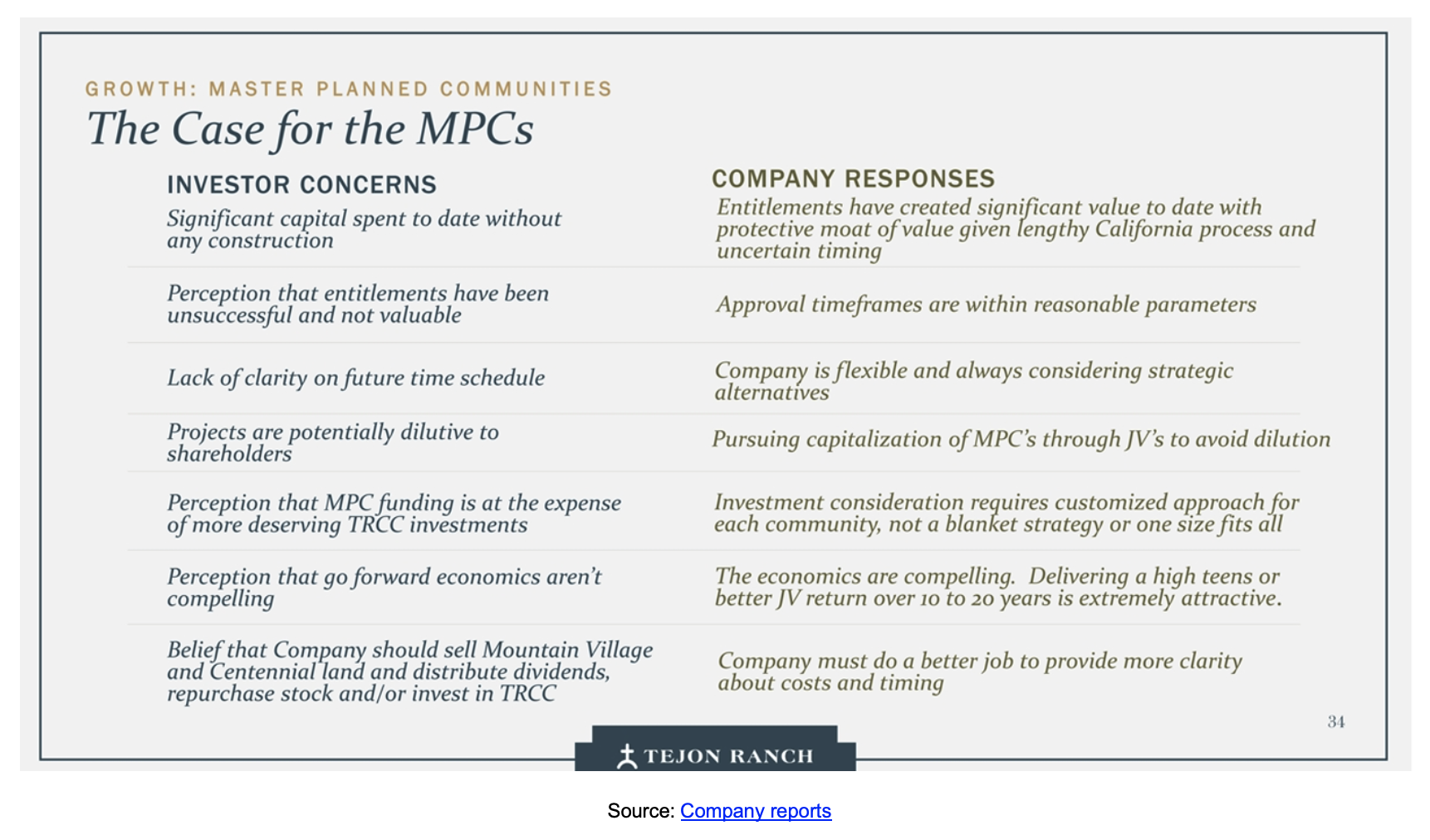
The company made clear that financing for these projects would involve project-level joint venture partner funding that would not be dilutive to TRC shares. Given that construction would be at least 2-3 years from now, we believe the timeline does not meet shareholder objectives. Investors are looking for an earlier catalyst. The company has been criticized by key shareholders in recent quarters for not leveraging its assets – which could provide much-needed industrial, commercial, and residential space for the state of California – to deliver value to shareholders.
SUBSCRIBE TO ZACKS SMALL CAP RESEARCH to receive our articles and reports emailed directly to you each morning. Please visit our website for additional information on Zacks SCR.
DISCLOSURE: Zacks SCR has received compensation from the issuer directly, from an investment manager, or from an investor relations consulting firm, engaged by the issuer, for providing research coverage for a period of no less than one year. Research articles, as seen here, are part of the service Zacks SCR provides and Zacks SCR receives payments totaling a maximum fee of up to $50,000 annually for these services provided to or regarding the issuer. Full Disclaimer HERE.